Cheapest Way to Ship Household Goods to Australia

Shipping household goods from the UK to Australia is not about finding the lowest price — it’s about avoiding the decisions that become expensive later.
What looks like a cheap quote on paper often excludes essential elements such as customs clearance, quarantine handling, or professional export packing. Once these are added back in, the “budget” option can quickly become one of the most expensive mistakes in your move.
The most cost-effective approach is straightforward: choose the correct shipping method, control your shipment volume, and ensure your quote reflects the true total cost door-to-door, not just the shipping rate.
All shipments entering Australia are regulated by the Australian Border Force and the Department of Agriculture, Fisheries and Forestry. These authorities enforce strict customs and biosecurity controls, which directly affect both costs and delivery timelines.
What Is the Cheapest Way to Ship to Australia?
For most households, the cheapest way to ship to Australia is sea freight, but the right option depends entirely on your shipment size.
Smaller moves are typically best suited to groupage (shared container shipping), where you only pay for the space your belongings occupy. Larger households benefit from a full container load (FCL), where the cost per cubic metre becomes significantly lower as volume increases.
Air freight exists as an option, but it is rarely cost-effective for full household moves. It is generally used only for essential or time-sensitive items due to its significantly higher cost.
The key point is that “cheapest” does not mean lowest upfront quote, it means lowest total cost once all services, handling, and destination requirements are included.
Shipping Methods Compared (Cost vs Value)
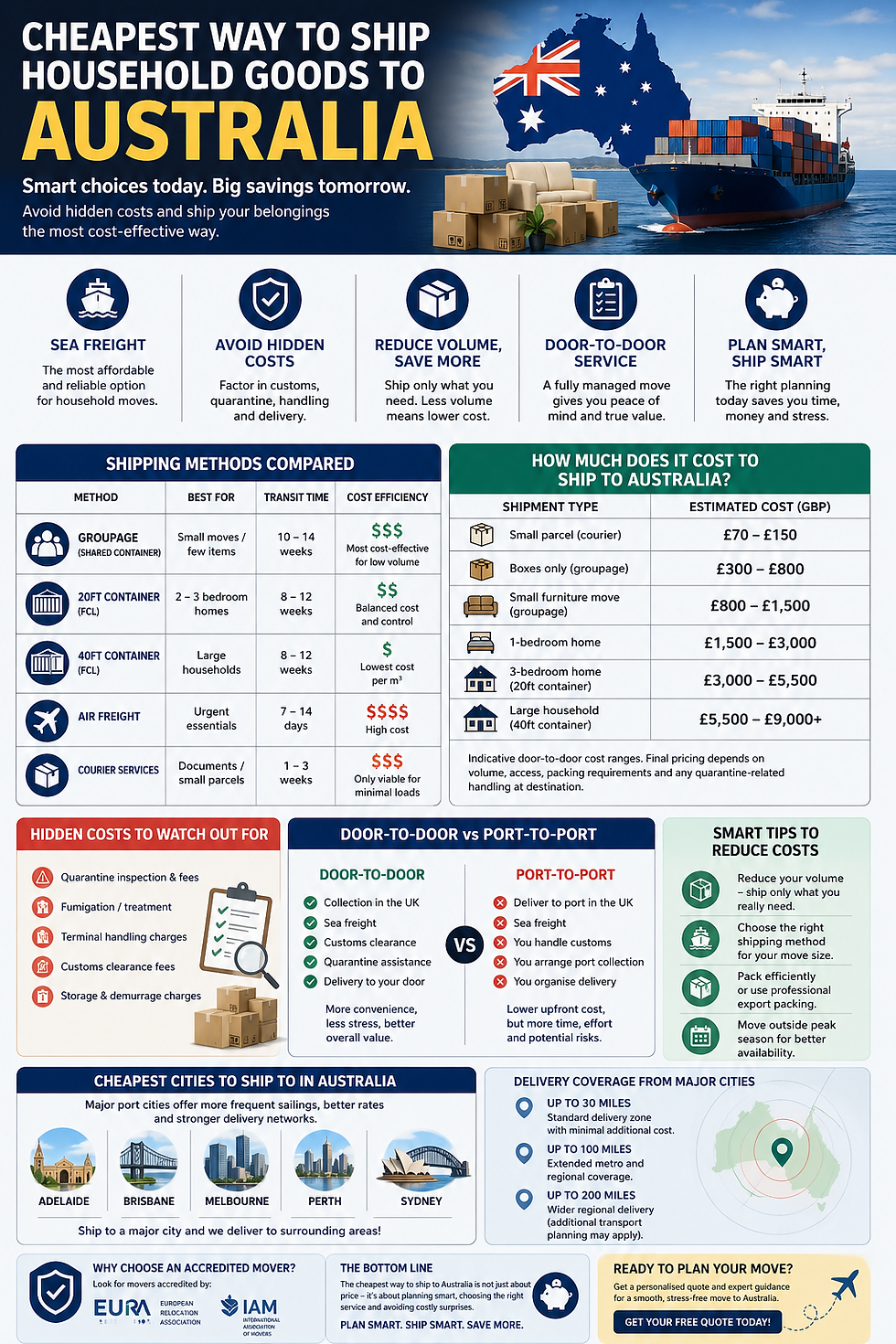
Shipping Method | Best For | Transit Time | Cost Efficiency |
Groupage (Shared Container) | Small moves / few items | 10–14 weeks | Most cost-effective for low volume |
20ft Container (FCL) | 2–3 bedroom homes | 8–12 weeks | Balanced cost and control |
40ft Container (FCL) | Large households | 8–12 weeks | Lowest cost per m³ |
Air Freight | Urgent essentials | 7–14 days | High cost |
Courier Services | Documents / small parcels | 1–3 weeks | Only viable for minimal loads |
Why We Do Not Offer LCL for Household Goods Shipments
While groupage (shared container shipping) is widely used for smaller moves, it is important to understand how it is structured, particularly for long-distance routes such as the UK to Australia.
In many cases, what is commonly referred to as “LCL shipping” operates under a port-to-port model where destination charges are not fully controlled or clearly defined at the time of booking. This can lead to significant variations in final costs once the shipment arrives.
At the destination port, additional charges may apply for:
terminal handling
container deconsolidation
customs processing
quarantine inspection and handling
These costs are often set by third-party agents and port authorities, meaning they are not always fixed or predictable in advance. As a result, what initially appears to be a lower-cost option can increase substantially by the time the shipment is released.
For this reason, structured international removals services avoid unmanaged LCL models for household goods. Instead, shipments are handled through controlled groupage services or dedicated containers, where pricing, handling, and delivery are clearly defined from the outset.
This approach ensures:
transparent, all-inclusive pricing
controlled handling at both origin and destination
reduced risk of unexpected charges
a smoother and more predictable delivery process
For full household moves, where volume, handling, and compliance all play a critical role, a managed service structure provides significantly better cost control than unmanaged LCL shipping.
Cheapest Australian Cities to Ship Household Goods To (UK → Australia)
When planning a move from the UK to Australia, your destination city plays a major role in the final cost. The most cost-effective locations are typically major port cities with regular container arrivals and strong logistics infrastructure.
Shipments to primary Australian gateways are generally faster, more frequent, and more competitively priced due to consistent vessel schedules and established delivery networks.
The most cost-effective cities to ship to include:
Adelaide
Brisbane
Melbourne
Perth
Sydney
These locations benefit from regular groupage (shared container) and full container shipments, making them the most efficient entry points for international removals.
Why These Cities Are More Cost-Effective
Major Australian cities are serviced by frequent shipping routes from the UK, which means:
better container availability
lower handling costs
faster consolidation for groupage shipments
reduced risk of delays
In contrast, regional or remote areas often require additional inland transport, which increases both cost and delivery time.
Delivery Coverage Beyond Major Cities
Shipping to a major port city does not mean you need to live there. Most international removals services include extended delivery coverage inland, allowing you to reach surrounding towns and regions without arranging separate transport.
Typical delivery coverage includes:
Distance from City | What It Means for Your Move |
Up to 30 miles | Standard delivery zone with minimal additional cost |
Up to 100 miles | Extended metro and regional coverage |
Up to 200 miles | Wider regional delivery (may involve additional transport planning) |
This means you can ship your belongings to cities such as Sydney or Melbourne and still have them delivered directly to nearby regional areas as part of a door-to-door service.

City-by-City Cost Efficiency Overview
Sydney
Sydney is one of the busiest international shipping hubs in Australia, offering frequent vessel arrivals and strong delivery infrastructure. This makes it one of the most efficient and predictable destinations for UK shipments.
Melbourne
Melbourne is a key logistics hub with high container volume, making it highly competitive in terms of pricing. It is often one of the most cost-effective destinations for full container shipments.
Brisbane
Brisbane serves Queensland and surrounding regions, with regular shipping schedules and good inland distribution networks. It is a strong option for both groupage and full container moves.
Perth
Although geographically further from the UK, Perth remains cost-effective due to direct shipping routes and strong port operations. It is often the preferred entry point for Western Australia.
Adelaide
Adelaide offers efficient handling and less congestion compared to larger ports, which can result in smoother processing and reliable delivery timelines.
Key Insight
The cheapest way to ship to Australia is not just about the shipping method — it’s also about choosing the right destination strategy.
Shipping to a major city and delivering within a 30, 100, or even 200-mile radius is often significantly more cost-effective than arranging direct delivery to remote or less accessible locations.
Pro Tip
If your final destination is in a regional area, it is often more cost-efficient to:
ship to the nearest major city
then complete delivery as part of a structured door-to-door service
This avoids fragmented logistics and reduces the risk of additional handling charges.
How to Reduce Shipping Costs (Without Cutting Corners)
Cost reduction in international removals is driven by decisions made before the shipment leaves the UK.
The most effective strategy is reducing volume. Since sea freight is priced by space, every item removed from your shipment lowers your cost directly. Items with low replacement value, particularly bulky furniture, are often better sold or replaced after arrival in Australia.
Choosing the correct container size is equally important. An oversized container results in paying for unused space, while an undersized solution leads to inefficient pricing structures. A properly assessed inventory ensures that your shipment matches the most cost-effective transport option.
Packing efficiency also plays a major role. Professionally packed shipments are typically more compact, better protected, and fully compliant with international shipping standards. Inefficient packing increases volume and may lead to additional handling or inspection at destination.
Finally, timing can influence availability and cost. Shipping outside peak demand periods helps avoid capacity pressure and reduces the likelihood of surcharges, particularly on long-distance routes.
Hidden Costs Most People Miss
The majority of unexpected costs occur at the destination, not during transit.
Quarantine inspection is mandatory for all shipments entering Australia. Depending on the condition and type of goods, additional treatment such as cleaning or fumigation may be required. These are regulated processes and cannot be avoided.
Destination terminal handling charges are another key factor. These cover the physical handling of shipping containers at the port and are sometimes excluded from lower-cost quotes.
Customs clearance must also be properly managed. Incomplete or incorrect documentation can result in delays, additional charges, or extended storage at the port.
Storage and demurrage fees may apply if shipments are not cleared or collected within the allowed timeframe. These charges accumulate quickly and are often overlooked during the quoting stage.
A lower initial quote often reflects excluded services rather than genuine savings.

Door-to-Door vs Port-to-Port: What Actually Saves Money?
Port-to-port services may appear cheaper because they exclude collection and delivery, but this comparison is often misleading.
When choosing port-to-port, you are responsible for managing transport to the UK port, coordinating customs clearance in Australia, attending quarantine inspections, arranging port collection, and organising final delivery.
In practice, this introduces complexity, multiple service providers, and additional costs that are not always visible upfront.
Door-to-door services provide a structured and fully managed process, reducing the risk of delays, errors, and unexpected charges. While the initial price may appear higher, the total cost is often more predictable and, in many cases, more economical overall.
Australia Delivery Reality (What Most Guides Don’t Explain)
The final stage of delivery in Australia is often the most complex part of the move.
In many locations, large shipping containers cannot access residential properties due to space restrictions or local regulations. As a result, shipments are often unloaded at a depot and transferred to smaller vehicles for final delivery.
This additional handling stage must be planned in advance. Without proper coordination, it can lead to delays and increased costs.
Quarantine inspections can also affect delivery timelines. Shipments selected for inspection may be held until clearance is granted, and in some cases, additional treatment may be required before release.
Understanding these factors is essential when evaluating quotes and planning your move.
How Much Does It Cost to Ship Household Goods to Australia?
The cost of shipping household goods to Australia depends on your shipment size, service level, access conditions, and final destination. Sea freight is typically priced based on volume, meaning the more space your belongings take, the higher the cost.
The ranges below provide a realistic guide for UK to Australia moves:
Shipment Type | Estimated Cost |
Small parcel (courier) | £50 – £150 |
Boxes only (groupage / shared container) | £300 – £800 |
Small furniture move (groupage) | £800 – £1,500 |
1-bedroom home | £1,500 – £2,800 |
3-bedroom home (20ft container) | £3,000 – £5,500 |
Large household (40ft container) | £5,000 – £8,500+ |
These are indicative ranges based on standard door-to-door services. Final pricing can vary depending on factors such as packing requirements, delivery access, storage needs, and any quarantine-related costs upon arrival in Australia.
The most accurate way to determine your cost is through a detailed survey of your belongings, ensuring the correct volume and shipping method are selected from the start.

Choosing a Reliable International Mover
The difference between a smooth relocation and a costly experience often comes down to the provider you choose.
Accreditation is one of the strongest indicators of reliability in international removals. Organisations such as the European Relocation Association EURA and the International Association of Movers represent recognised standards across the global moving industry, with members expected to meet strict operational, service, and compliance requirements.
Working with an accredited mover helps ensure that your shipment is handled professionally at every stage, from export packing in the UK to customs clearance and delivery in Australia.
A well-structured international moving service should include:
a clear and fully itemised quote with no hidden elements
guidance on the most cost-effective shipping method based on your volume
compliant handling of customs and quarantine requirements
realistic and transparent expectations around transit and delivery timelines
Companies such as Reloux International Moving Company operate with a fully managed, door-to-door approach, ensuring that each stage of the move is coordinated, controlled, and clearly communicated from the outset.
Final Insight: Cheapest vs Smartest Choice
The cheapest way to ship household goods to Australia is:
Groupage (shared container) for smaller shipments
Full container (FCL) for larger households
But the smartest — and often most cost-effective — approach is a move that is properly planned, professionally managed, and fully inclusive from the start.
Saving money on paper means very little if it leads to delays, additional charges, or complications at the destination.
Frequently Asked Questions
What is the cheapest way to ship household goods to Australia from the UK?
The cheapest way to ship household goods to Australia from the UK is groupage (shared container shipping) for smaller moves, where you only pay for the space your items occupy. For larger households, a full container load (FCL) becomes more cost-effective, as the cost per cubic metre decreases with volume. The most economical choice depends on your shipment size, access conditions, and whether a full door-to-door service is included.
Is sea freight cheaper than air freight to Australia?
Yes, sea freight is significantly cheaper than air freight and is the standard method for international removals. Air freight can cost five to ten times more per cubic metre, making it suitable only for urgent or high-value items. For furniture and full household moves, sea freight offers the best balance between cost and practicality.
Are there hidden costs when shipping household goods to Australia?
Yes, and most of these costs occur at the destination. Common additional charges include quarantine inspection fees, fumigation for wooden items, destination terminal handling charges, and customs clearance fees. These are often excluded from low-cost quotes, which is why it is essential to compare fully inclusive, door-to-door pricing to avoid unexpected expenses.
Is port-to-port shipping cheaper than door-to-door removals?
Port-to-port shipping usually has a lower upfront price because it excludes collection and delivery. However, it is often more expensive overall, as you must arrange UK transport, customs clearance, quarantine handling, port collection, and final delivery yourself. Door-to-door removals provide a fully managed service, making them more cost-effective and less complex for most households.
How much does it cost to ship household goods to Australia?
The cost of shipping household goods to Australia typically ranges from £1,500 for small box shipments to £8,000+ for large household moves, depending on volume, service level, and destination. Smaller moves using groupage are the most affordable, while full container shipping offers better value for larger relocations.
How long does shipping to Australia take from the UK?
Shipping household goods from the UK to Australia usually takes 8 to 14 weeks by sea freight, depending on whether you use groupage or a full container. Groupage shipments may take slightly longer due to consolidation at the UK port, while full container shipments are typically faster and more direct.
Can I reduce shipping costs by packing my own belongings?
Self-packing can reduce upfront costs, but it may increase overall expenses if items are packed inefficiently, increasing shipment volume. In addition, some international shipments require professional export packing to meet customs and quarantine standards, particularly for Australia. In many cases, professional packing results in better space efficiency and fewer delays.

Plan Your Move to Australia with Clarity — Not Guesswork
Shipping to Australia is one of the most regulated and detail-sensitive international moves. The difference between a smooth relocation and unexpected costs usually comes down to how well the move is planned before anything is packed.
A properly structured move ensures:
the right shipping method (groupage or full container)
compliant export packing
smooth customs clearance
controlled delivery at destination
Without this, delays, additional charges, and complications at the Australian border are far more likely.
If you want a clear understanding of your move before committing, a tailored quote based on your actual belongings is the most reliable place to start.
Request a detailed, door-to-door quote with full cost breakdown — so you know exactly what to expect from the beginning.
Companies such as Reloux International Moving Company provide structured surveys (video or in-person) to assess volume, access, and logistics in advance — helping avoid the common pricing and planning mistakes that often occur with generic estimates.
Reference & Further Information
Understanding official requirements is essential when planning a move to Australia. The following sources provide reliable guidance on customs, biosecurity, and relocation preparation:
Australian Border Force
Covers import rules, customs procedures, and documentation requirements for personal belongings entering Australia.
Offers guidance on exporting personal belongings from the UK and customs-related processes.
Before You Ship: One Key Step Most People Miss
Before confirming your move, use a volume calculator or survey to estimate how much you’re actually shipping. Choosing the wrong shipping method is one of the most common reasons people overpay when moving to Australia.