How to Move Your Belongings from the UK to Switzerland

Moving your home from the UK to Switzerland involves more than arranging transport. You will need to plan what to take, prepare a clear inventory, provide documents for Swiss customs and coordinate the delivery around your new address and access arrangements.
This guide explains the main steps for moving household goods from the UK to Switzerland, including how customs treatment works when you are transferring your residence, what paperwork to prepare and how to choose a suitable removals service.
At a glance: If you are transferring your residence to Switzerland, many used household effects can generally be imported without customs duties when they meet the Swiss conditions. Items must normally have been used by you personally for at least six months and continue to be used by you after import. Form 18.44 and supporting documents are required. Customs eligibility depends on your circumstances and the goods being imported, so confirm your case before shipping.

Who this guide is for
This guide is for people planning a household move from the UK to Switzerland, whether they are relocating for work, joining family, returning to Switzerland or moving their personal effects to a new home. It focuses on household goods and personal belongings. Vehicles, pets, alcohol, weapons, antiques and other regulated items can involve separate rules and should be checked individually.
1. Decide what you want to move
Start by reviewing each room and deciding what is worth transporting. Consider the size and layout of your Swiss home, whether large furniture will fit, and the cost of replacing lower-value items after arrival. Moving is also a useful opportunity to sell, donate or recycle belongings you no longer need.
Prepare a room-by-room list that includes furniture, appliances, boxes and any unusually valuable or restricted items. The inventory helps a moving company estimate the shipment volume and helps customs identify the goods. Swiss customs guidance says ordinary boxes may be grouped by contents, while larger items, valuable objects, appliances and restricted goods should be described individually and in more detail.
Before requesting a quotation | Information to gather |
Goods | A room-by-room inventory, approximate number of boxes and large or fragile items |
Collection | UK address, access, parking, stairs, lift and any building restrictions |
Delivery | Swiss address, access details, floor level, lift dimensions and parking arrangements |
Timing | Preferred collection and delivery periods, plus any date constraints |
Customs | Whether you are transferring your residence and when you expect to move |
An accurate inventory and clear access information help the mover assess the work and recommend an appropriate service. If your list changes after the quotation, ask for it to be reviewed because changes to volume, packing or access may affect the price and arrangements.
2. Choose a suitable removals service
The right service depends on the size of your shipment, your dates and how much support you want with preparation. A professional international removals service can help coordinate packing, collection, export arrangements, transport, customs paperwork and delivery. Confirm exactly which services are included in your quotation.
For a smaller shipment, a shared-load service may be an option if the route and schedule suit your move. Your belongings travel with other customers' consignments, so collection and delivery dates may be arranged within a wider schedule. A dedicated vehicle provides more exclusive use of the transport, which can suit larger shipments or tighter timing requirements. Availability and suitability should be confirmed against your inventory and preferred dates.
Service point | Shared-load service | Dedicated vehicle |
Best suited to | Smaller or less time-sensitive shipments | Larger moves or moves needing more control over the vehicle schedule |
Scheduling | Coordinated with other consignments | Planned around one household's collection and delivery requirements |
Delivery timing | Usually requires flexibility within the agreed service window | May offer more control, subject to route and availability |
Quotation basis | Shipment volume, service requirements and route schedule | Vehicle, route, access and service requirements |
Ask whether export packing, dismantling and reassembly, customs administration, delivery inside the property and removal of packing materials are included or optional. “Door to door” describes the collection and delivery points; it does not automatically mean every packing or unpacking service is included.
3. Check Swiss customs requirements early
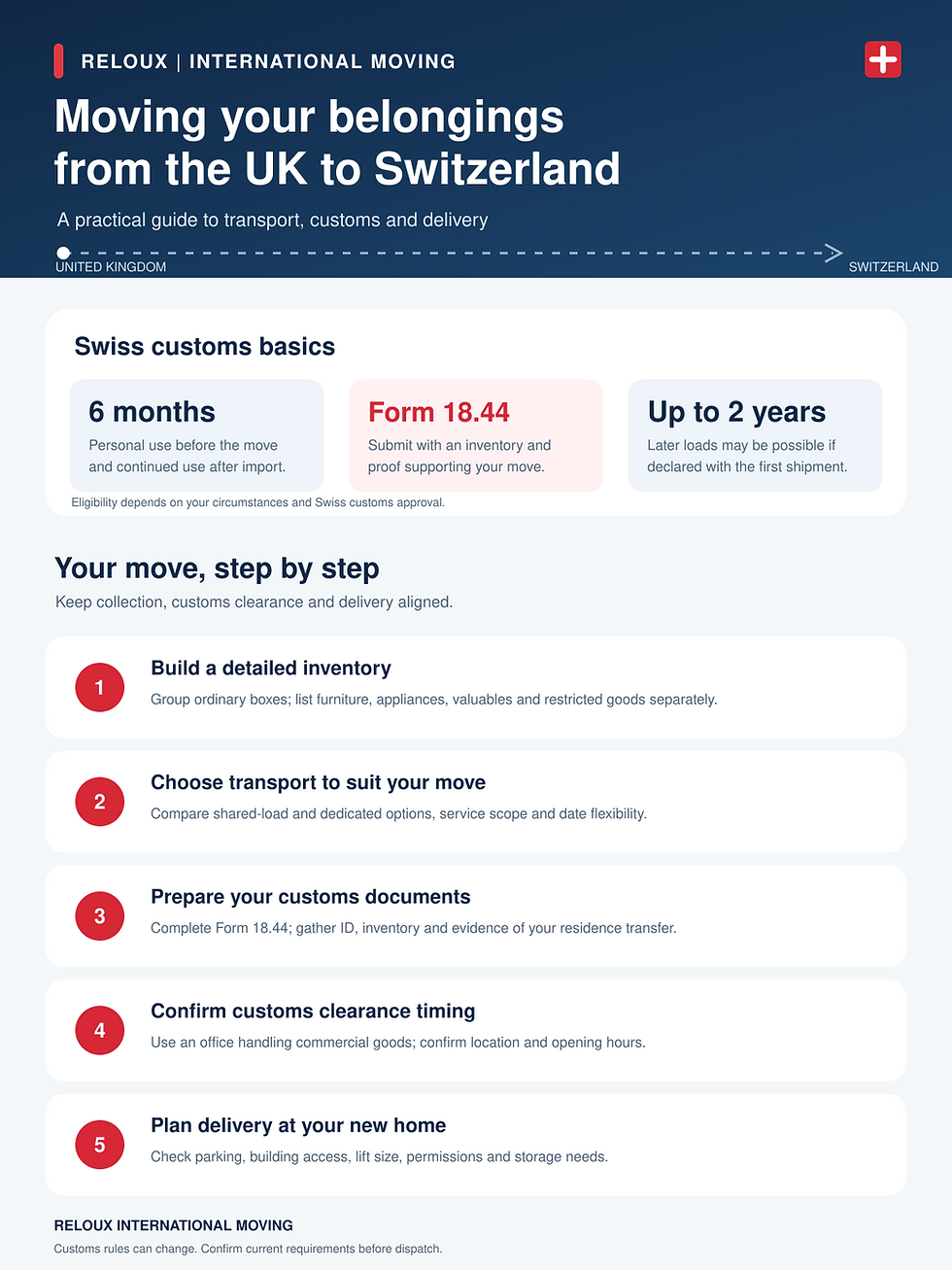
Switzerland has its own customs territory, so household goods shipped from the UK must be declared when they enter Switzerland. If you are transferring your residence, many household effects may qualify for duty-free import as removal goods, provided the relevant conditions are met.
The Swiss Federal Office for Customs and Border Security (FOCBS) states that the transfer of domicile is a key condition. The goods must generally have been used by you personally for at least six months before import and must continue to be used by you after arrival. New purchases or items that do not meet the conditions may need to be declared separately and may be subject to duties or taxes.
The main customs form for household effects is Form 18.44. The shipment also needs a detailed inventory and evidence supporting the transfer of residence. Depending on your
situation, useful documents may include:
Passport or other identity document
Completed Form 18.44
Detailed inventory of the goods
Swiss residence permit, if available, or other evidence of the move, such as an employment contract or tenancy agreement
Evidence of departure from your previous country of residence, where applicable
Proof of purchase or rental of your Swiss accommodation, where applicable
The customs office makes the final decision about whether the documents and goods qualify. If you will not have every document at the time of import, provisional clearance may be possible in some cases, but a guarantee may be required. Arrange this with the relevant customs authority and your moving company before dispatch.
Swiss customs clearance for household effects must be handled at an office competent for commercial goods and during its opening hours. Confirm the correct office and timing with your mover or customs representative before the shipment travels. Do not assume that a standard passenger-car lane or a weekend arrival will work for a household shipment.
4. Plan the timing of your shipment
Your collection date, customs clearance and delivery date need to work together. Share your expected move date and preferred shipping window with the moving company as early as you can, especially if you need packing, storage or a fixed delivery appointment.
Swiss customs guidance allows eligible household effects to be imported in later consignments within two years of the transfer of residence, subject to the conditions. If you plan to send belongings in stages, tell customs about the later shipment when the first consignment is declared and follow the instructions provided. Keep copies of the stamped customs documents for any subsequent shipment.
Avoid booking delivery before you have checked access at the Swiss address. Narrow streets, restricted vehicle access, parking rules, building permissions, stairs and lift sizes can affect the vehicle and crew required. If access is limited, tell your mover before accepting the quotation so they can assess whether extra handling or a smaller vehicle is needed.

5. Prepare for packing and collection
Before packing begins, separate items that are travelling with you from those going with the removal shipment. Keep passports, residence paperwork, medicines, keys, essential documents and valuables with you. Do not pack items that are prohibited or require separate approval without first checking the rules.
If you are using a professional packing service, the crew can prepare goods for international transport and label boxes for delivery. Point out fragile, unusually heavy or high-value items and any furniture that needs dismantling. If you are packing some cartons yourself, ask the mover how they should be prepared and labelled, and whether cartons need to remain open for inspection or sealing.
Take photos of valuable items and keep a copy of the final inventory and quotation. If you are considering moving insurance, review the policy wording, valuation requirements, excess and exclusions before the move. Insurance is separate from customs relief and does not remove the need to declare goods accurately.
6. Coordinate delivery at your Swiss home
Before dispatch, confirm the delivery address, contact details, access arrangements and any building or parking permissions. If your new home will not be ready, ask whether storage is available and how charges, handling and later delivery would work. Storage can affect the overall schedule, so include it in the plan from the beginning.
On delivery day, check the goods against the inventory and note any visible damage or missing items on the delivery paperwork before signing. Follow the procedure in your moving contract for reporting any concerns and keep photographs and copies of relevant documents.
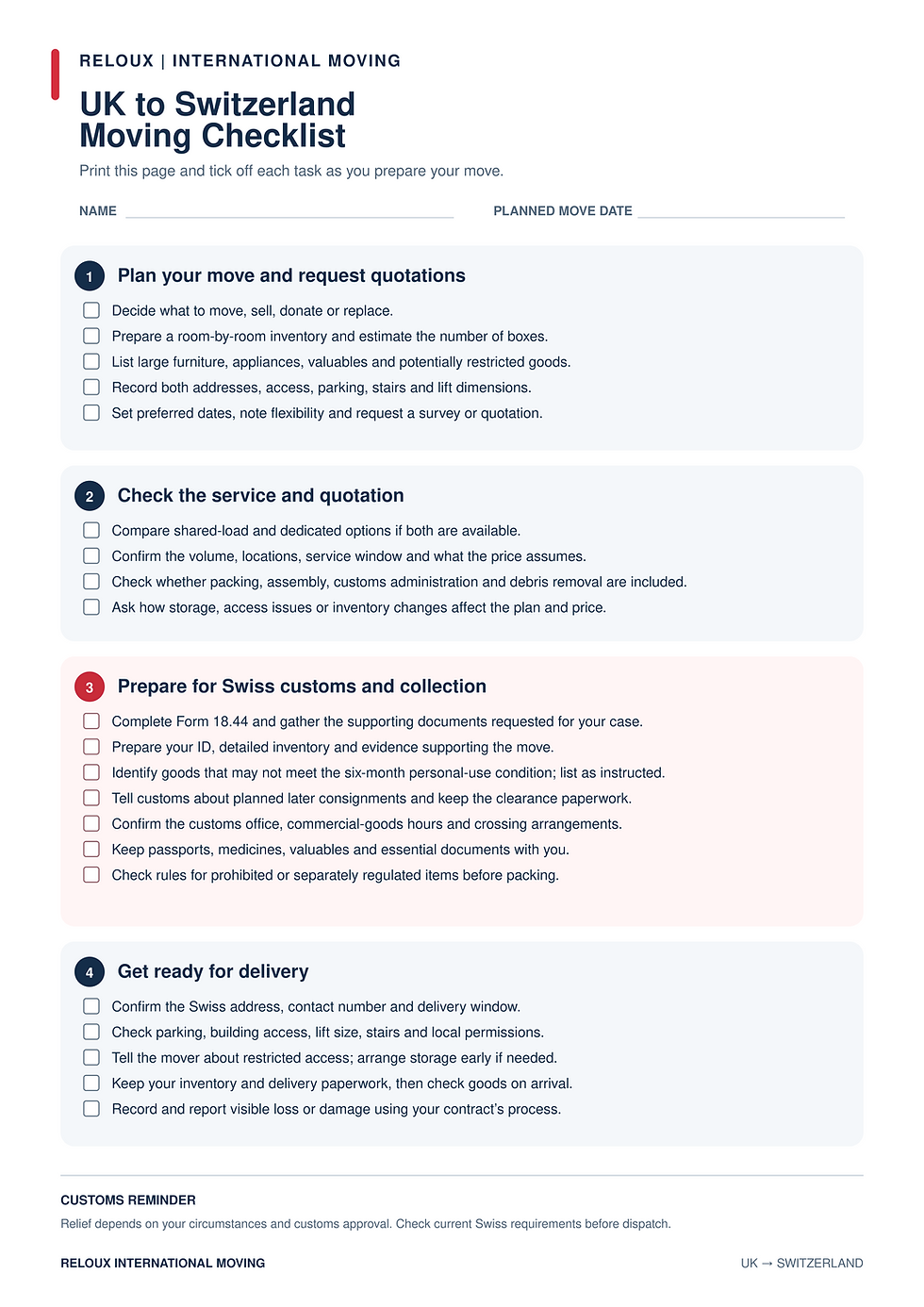
A practical UK-to-Switzerland moving checklist
Before booking
Decide what to move, sell, donate or replace.
Create an inventory with a separate description for large, valuable or restricted items.
Gather collection and delivery access details.
Request a survey or quotation based on the intended inventory.
Compare shared-load and dedicated-vehicle options if both are available for your move.
Before collection
Confirm the inventory, service scope, dates and payment schedule.
Complete Form 18.44 and assemble the supporting customs documents.
Confirm the customs office and clearance arrangements with your mover.
Tell the mover about staged shipments, storage, special items and access restrictions.
Keep travel documents, medicines, valuables and essential paperwork with you.
Before delivery
Confirm that customs requirements have been met and agree a delivery appointment.
Check parking, building access, lift dimensions and any local permissions.
Arrange storage in advance if your home is not ready.
Check the shipment on arrival and report any issue using the agreed process.

Frequently asked questions
What documents do I need to move household goods to Switzerland?
You will generally need a completed Form 18.44, a detailed inventory and documents supporting your move to Switzerland. These may include your passport, Swiss residence permit if available, employment contract or tenancy agreement, and evidence of leaving your previous residence. The customs office decides whether the documents are sufficient for your circumstances.
Can I import my belongings duty-free if I am moving from the UK?
Many used household effects may qualify for duty-free import when you transfer your residence to Switzerland, provided the customs conditions are met. The goods must generally have been used by you personally for at least six months and continue to be used by you after import. New or ineligible items may be liable for charges and should be identified separately on the inventory.
Do I need my Swiss residence permit before my shipment arrives?
Not always. Swiss customs may accept other evidence of your transfer of residence, such as an employment contract, tenancy agreement or departure documents. If your paperwork is incomplete, provisional clearance may be possible, but customs may require a guarantee. Check your documents with the customs office or customs representative before dispatch.
What is Form 18.44, and who completes it?
Form 18.44 is the Swiss customs form for declaring household effects as removal goods. The person moving should provide accurate information and sign the required declarations. A removals company or customs representative may help prepare the file, depending on the service quoted, but you remain responsible for supplying correct details and supporting documents.
Do I need to list every item individually?
No. Ordinary cartons can usually be grouped by contents and quantity, such as “10 boxes of clothing” or “6 boxes of kitchenware.” List bulky furniture, appliances, valuable objects and restricted goods individually with enough detail to identify them. Keep new or recently purchased items separate and show their values as instructed.
Can my belongings arrive before I move to Switzerland?
Duty-free treatment is based on transferring your residence and meeting the customs conditions. If your goods will arrive before you have completed the move or obtained usual proof of residence, clearance may be more complicated and a guarantee could be required. Discuss the sequence of your move and shipment with the customs office or destination agent before booking dispatch.
Can I send my belongings in several shipments?
This may be possible. Tell customs about planned later consignments when the first shipment is declared, and provide a separate list as instructed. Eligible later consignments may generally be imported within two years of the transfer of residence, subject to the rules. Keep the customs documents from the first clearance.
When and where are household goods cleared through Swiss customs?
Household effects must be declared at a Swiss customs office that handles commercial goods, during its applicable opening hours. Some offices have different schedules, and weekend clearance should not be assumed. Confirm the correct office and crossing arrangements with your mover or customs representative before the vehicle travels.
Will I have to pay Swiss customs charges or taxes?
This depends on whether the shipment and your circumstances qualify for relief. Goods that do not meet the conditions, including some recent purchases, may be liable for duties or taxes. A moving quotation may include customs administration or agent fees, but those are different from any duties, taxes or guarantee customs may require. Check what the quotation includes and ask how any potential customs charges will be handled.
How much does it cost to move from the UK to Switzerland?
The price depends on the shipment volume, packing requirements, collection and delivery access, transport option, timing and any storage or extra services. Bedroom count alone is not enough to provide a reliable estimate. A survey or detailed inventory allows the mover to assess your particular move.
How long does a removal to Switzerland take?
The schedule depends on the route, service option, collection and delivery locations, customs processing and availability. Shared-load services may need more flexibility around collection and delivery dates. Ask for the expected service window for your shipment and allow time to prepare the customs documents.
Does a door-to-door quotation include packing and unpacking?
Not automatically. Check the written quotation for export packing, unpacking, furniture dismantling and reassembly, delivery inside the home, customs administration and removal of packing materials. The quotation should show which services are included and which are optional.
Can I move a car, pet or restricted item with my household goods?
Vehicles, pets and goods such as alcohol, weapons or items made from protected species may have additional customs, permit or veterinary requirements. Tell your mover about them before booking and check the relevant Swiss authority's current rules. Do not assume they can be cleared as ordinary household effects.
Planning your move to Switzerland with Reloux
A well-prepared inventory, suitable transport plan and complete customs file can make your UK-to-Switzerland move easier to coordinate. Contact Reloux International Moving to discuss your collection address, destination, approximate volume, preferred dates and any access or customs questions. A survey can help establish the shipment requirements and the services to include in your quotation.
Official Swiss customs information
By Reloux Editorial Team · Reviewed 28 September 2026. Customs rules and procedures may change; confirm the current requirements with Swiss customs before your shipment is dispatched.