
International Removals from the UK to Canada: How to Plan Your Household Move

Planning a move to Canada involves more than choosing a shipping date. You need to decide which belongings to take, understand the available transport options, prepare your customs documents and arrange delivery around your new home.
Whether you are relocating to Toronto, Vancouver, Montreal, Calgary or another destination, the most useful starting point is a clear inventory and a quotation based on your actual requirements.
International removals from the UK to Canada typically involve a survey, export packing, collection, sea or air freight, customs clearance and final delivery.

The cost and timescale depend on the packed volume, shipping method, destination, property access and any additional services.
This guide explains how to plan each stage, compare removal quotations and prepare your household belongings for the journey.
Who is this guide for?
This guide is for people moving household goods and personal belongings from the UK to Canada, including:
Families relocating with furniture and the contents of their home.
Individuals and couples moving for work or personal reasons.
Canadian residents returning after living in the UK.
People shipping a smaller selection of furniture and boxes.
Customers who need storage while searching for a Canadian property.
Anyone comparing shared container shipping with a sole-use container.
The practical planning advice applies to many household moves. However, customs requirements depend on your circumstances. New settlers, returning residents, students and temporary residents should confirm the rules relevant to their situation.
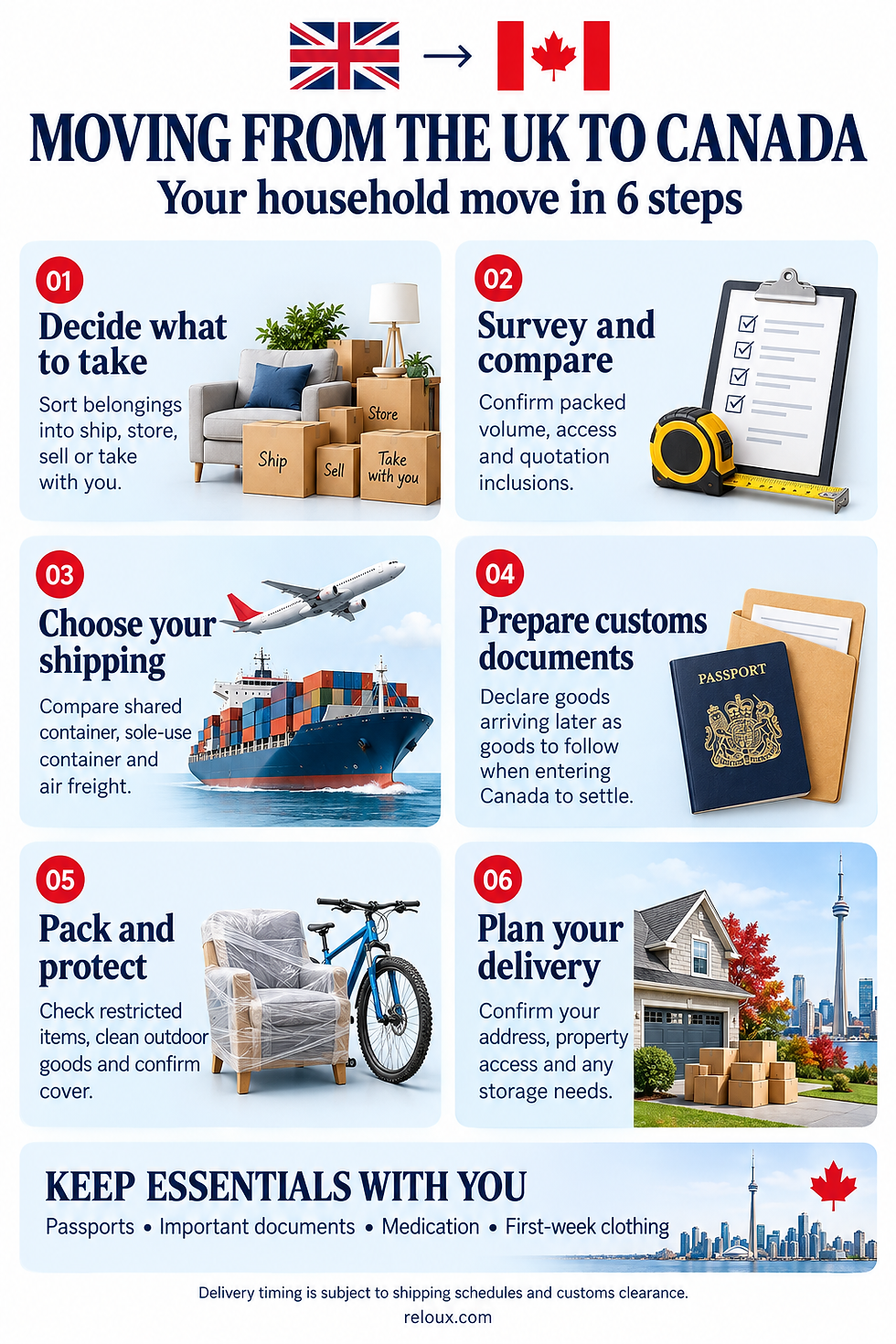
1. Decide what you want to take to Canada
Before requesting a detailed quotation, work through your home and decide which belongings are likely to travel.
Your shipment size affects packing requirements, transport costs, storage and delivery arrangements. Including furniture you later decide to sell can make an early quotation less useful. Adding substantial items after booking can also change the price and space required.
A simple approach is to divide your belongings into four groups:
Ship: furniture and possessions you want in your Canadian home.
Take with you: travel documents, essential clothing and items needed immediately.
Store: belongings you are keeping but do not yet want shipped.
Sell, donate or dispose of: items that are unsuitable or unnecessary.
Is it worth shipping furniture to Canada?
Consider the additional shipping cost alongside the item’s condition, replacement cost and usefulness in your new home.
A good-quality dining table, comfortable sofa or sentimental piece may be worth taking. A bulky, inexpensive wardrobe that does not fit your future property may be less worthwhile.
Before making a decision, ask:
Will the furniture suit the size and layout of my new home?
Can it pass through the doors, stairs and lifts?
Will it need dismantling or specialist packing?
Would replacing it be straightforward?
Will I need to pay to store it before delivery?
If you have not chosen your Canadian property, measure your largest pieces and keep a record. These dimensions can help when comparing homes.
2. Arrange a survey before confirming your removal service
A survey helps establish the volume of your belongings and the practical work involved in moving them.
During a video or home survey, show the surveyor everything you intend to send, including items in the loft, garage, shed and storage areas.
Highlight any belongings that need particular attention, such as:
Large mirrors and glass furniture.
Artwork and antiques.
Stone or ceramic tabletops.
Pianos and unusually heavy items.
Furniture requiring dismantling.
Fragile collections.
Items already packed or held in storage.
Explain access at your UK property, including stairs, lift dimensions, parking restrictions and the distance between the vehicle and entrance.
Why packed volume matters
The space your belongings occupy after export packing can differ from their unpacked dimensions. Protective materials, crates and the shape of furniture affect the final shipment.
Ask your mover to explain the volume allowance in the quotation and how any difference will be handled.
A quotation based on a survey and a confirmed inventory is more useful than a price based only on the number of bedrooms.

3. Compare your UK-to-Canada shipping options
The right shipping method depends on the amount you are moving, your budget and how flexible you can be with delivery.
For household removals, the main options to discuss are shared container shipping, a sole-use container and air freight.
Shipping option | When it may suit your move | Main planning consideration |
Shared container or groupage | Smaller household shipments and customers with flexible timing | Consolidation and combined delivery arrangements affect the schedule. |
Sole-use container | Larger household moves or customers wanting exclusive container use | Compare the total container cost with your shipment volume and requirements. |
Air freight | A limited selection of urgent belongings | Check chargeable weight and whether collection, clearance and home delivery are included. |
Shared container shipping
With a shared container service, your belongings travel alongside other customers’ shipments.
This can be a practical option when you do not need the capacity of a whole container. Each shipment should be separately identified and supported by its own inventory.
Ask how the estimated delivery period is calculated. An estimate beginning at collection is different from one beginning when the container departs.
You should also understand whether consolidation time is included and when your mover expects to provide a clearer delivery update.
Sole-use container shipping
A sole-use container is reserved for your shipment.
This option is worth comparing when you are moving a substantial amount of furniture or prefer exclusive use of the container. However, it does not remove the effects of vessel schedules, customs clearance or destination delivery arrangements.
The appropriate container size should follow a volume assessment. Avoid assuming a particular container will accommodate your home based only on bedroom count.
Air freight
Air freight may be useful for a small selection of belongings needed before your main sea shipment arrives.
Ask whether the quotation covers delivery to your home or only transport to the destination airport. Also confirm how the packed dimensions and weight affect the charge.
If you split your belongings between sea and air freight, keep the inventories clear and coordinate the customs paperwork for both shipments.
4. Understand what affects the cost of removals to Canada
There is no single accurate price for every household move from the UK to Canada.
Two customers moving from the same UK town to the same Canadian city may receive different quotations because their volume, access, packing and delivery requirements differ.
The main cost factors include:
Packed volume: The amount of space your belongings require after packing.
Collection and destination: The UK collection address and the complete Canadian delivery address.
Shipping method: Shared container, sole-use container or air freight.
Packing requirements: Standard export packing, fragile packing, dismantling and bespoke crates.
Property access: Stairs, lifts, long carrying distances, parking restrictions or the need for a smaller delivery vehicle.
Storage: The duration, warehouse handling and eventual onward delivery.
Additional protection: The selected cover, declared values and applicable terms.
Small shipments may still involve minimum charges. Removing a few boxes will not necessarily reduce the price in direct proportion because some collection, handling and administration costs remain.
Compare quotations on the same basis
Before choosing an international removals company, check that you are comparing equivalent services.
Quotation detail | What to confirm |
Shipment volume | What volume is included, and how are additions or differences charged? |
Packing | Are cartons, protective materials, furniture wrapping and labour included? |
Specialist items | Are crates, heavy-item handling and dismantling allowed for? |
Freight | Which shipping service and destination are covered? |
Customs assistance | What support is provided, and what must you arrange personally? |
Destination charges | Which handling charges are included, and which may be additional? |
Delivery | Does the price cover your actual address and known access conditions? |
Unpacking | Are furniture unpacking, assembly and packaging removal included? |
Storage | Are receiving, handling, storage and redelivery separately charged? |
Protection | What cover is included or available, and what exclusions apply? |
Payment terms | When are the deposit and remaining balance due? |
A clear quotation should help you understand both the agreed service and the circumstances that could lead to extra charges.

5. Plan around the complete moving timeline
The time your belongings spend at sea is only one part of an international removal.
Your overall schedule can include:
Packing and collection.
Transport to the departure warehouse.
Storage or consolidation where applicable.
Container loading and departure arrangements.
International transport.
Arrival handling and customs clearance.
Final delivery scheduling.
For sea freight, plan in weeks rather than days and request a current estimate for your particular route and service.
Ask whether the estimate includes the entire period from collection to delivery, or only certain stages.
Keep your arrival plans flexible
Avoid relying on an unconfirmed shipment arrival date when arranging your first weeks in Canada.
Consider how you will manage if your belongings arrive after you:
Will your temporary accommodation be furnished?
Do you have suitable clothing for the season?
Can you work without the equipment being shipped?
Do children have the essentials they need?
Will your permanent home be available for delivery?
Keep passports, essential medication, important documents and immediate necessities with you.
A sole-use container can offer different scheduling arrangements from groupage, but neither option should be treated as a guaranteed delivery date unless a specific commitment has been confirmed in writing.
6. Prepare your Canadian customs information early
Eligible household goods may qualify for duty- and tax-free entry, subject to Canadian customs conditions.
For new settlers, goods generally need to have been owned, possessed and used abroad before arrival. Returning residents have different requirements and exceptions. Newly purchased goods and commercial items should not automatically be treated like used personal effects.
Understand “goods to follow”
If your belongings will arrive after you enter Canada to establish residence, they are generally described as goods to follow.
CBSA guidance explains that you should distinguish goods arriving with you from those arriving later and declare the latter at the relevant entry. Keep the customs-endorsed records for subsequent clearance.
Know the purpose of the BSF186 form
The BSF186 Personal Effects Accounting Document records your personal effects. It requests descriptions and values in Canadian dollars and allows additional lists, including BSF186A or a mover’s inventory.
Check how your packing inventory and customs documents should align. Confirm your responsibilities with the destination agent before dispatch, including any required attendance at a customs office.
Read the official CBSA guidance on moving or returning to Canada before travelling.
7. Check restricted items before packing
Do not assume that everything normally kept in a UK home can be included in your shipment.
Give your mover advance details of items such as food, alcohol, plants, seeds, medicines, batteries, aerosols and other potentially hazardous products. Obtain confirmation before packing them.
Import eligibility and a shipping company’s acceptance policy are separate considerations. An item may require specialist arrangements even where importation is possible.
Clean outdoor belongings carefully
Canada controls soil and related contamination because it can introduce pests and diseases. Outdoor items can therefore need particular attention.
Inspect and thoroughly clean:
Bicycle tyres and frames.
Gardening tools.
Outdoor furniture.
Camping equipment.
Walking boots and other outdoor footwear.
Check wheels, undersides and crevices, then allow items to dry before packing.
For food, plants and animal products, consult the Canadian Food Inspection Agency’s import guidance and confirm acceptance with your mover.

8. Arrange suitable export packing
International household moves can involve several handling stages. Packing should reflect the item’s fragility, dimensions and transport requirements.
Discuss how furniture will be protected, how cartons will be labelled and which pieces need additional preparation.
For fragile or valuable items, ask whether ordinary export wrapping is sufficient or whether a specialist crate is required. Arrange this early, as bespoke packing may need additional preparation time.
Can you pack your own boxes?
Discuss owner-packed cartons before booking.
Your mover may need to inspect the contents, check the inventory or repack cartons that are unsuitable for transport. Owner-packed goods can also be subject to different protection terms.
Avoid vague labels such as “miscellaneous”. Clear descriptions make it easier to identify contents and organise delivery.
Photograph furniture and valuable items before collection, and keep copies of the inventory and relevant paperwork.
9. Plan storage if your new home is not ready
You do not need to have every housing detail settled before discussing your move, but uncertainty should be included in the plan.
If you are initially staying with family or renting temporary accommodation, ask about storage before collection.
Storage in the UK
Holding belongings in the UK may give you time to confirm your destination address before dispatch.
Ask how storage affects the shipping schedule and what notice is needed when you are ready to proceed.
Storage in Canada
Destination storage may be useful if your shipment has already travelled or your property will become available shortly after arrival.
Check availability and the full cost before relying on this option.
For either location, compare:
Receiving and handling charges.
Weekly or monthly storage.
Minimum storage periods.
Access arrangements.
Protection while stored.
Release and final delivery charges.
The storage rate alone may not represent the total additional cost.
10. Prepare for delivery to your Canadian home
Your destination city is only the starting point for planning delivery.
Provide the full address and postal code as soon as possible, along with information about parking, stairs, lifts and vehicle access.
Apartments and condominiums
Check with the building management whether you need:
A service-lift reservation.
An allocated loading area.
A specific moving time slot.
Advance notice of delivery.
Documentation from the delivery company.
Arrange building permissions yourself unless your written booking expressly includes this service.
Houses and properties with restricted access
Tell your mover about narrow roads, steep driveways, limited parking and long distances between the vehicle and entrance.
If a large vehicle cannot reach the property, a smaller shuttle vehicle may be required. Identifying this early allows the arrangement and potential charge to be discussed before delivery.
Confirm the unloading and unpacking service
Delivery, unpacking and furniture assembly are different tasks.
Check whether your booking includes placing furniture in rooms, unwrapping furniture, unpacking cartons, reassembly and removing packing debris.
Make a basic room plan before delivery so you can direct the crew efficiently.
Common mistakes to avoid when moving to Canada
Booking before finalising the inventory. Significant additions can affect the price, materials and shipping arrangements.
Comparing freight-only prices with complete removal services. Check the full journey and destination charges.
Leaving customs preparation until the shipment arrives. Discuss your circumstances before travelling and before dispatch.
Assuming every item can be shipped. Flag restricted or unusual belongings in advance.
Overlooking access at the destination. Lift bookings, parking and smaller-vehicle requirements can affect delivery.
Packing essentials into the sea shipment. Keep what you need for travel and your first weeks separately.
Assuming cover is automatically included. Review the available protection, valuation requirements and exclusions.
Treating an estimate as a guaranteed date. Build your arrival arrangements around the confirmed service terms.
Frequently asked questions about international removals from the UK to Canada
How much do international removals from the UK to Canada cost?
The price depends on packed volume, the collection and delivery addresses, shipping method, access, packing and any storage requirements. A surveyed quotation gives a more useful basis for budgeting than a general price based on bedroom count. Ask what is included and how changes to your inventory would affect the charge.
What is the cheapest way to ship household belongings to Canada?
For a smaller shipment with flexible timing, shared container shipping is worth comparing. Reducing unnecessary volume may also help. Compare the complete delivered price, including packing, handling and access charges, rather than choosing on the freight figure alone.
How long do removals from the UK to Canada take?
The overall time depends on the service, departure arrangements, destination, clearance and final delivery schedule. Ask for a current door-to-door estimate and confirm when that estimate starts. Ocean transit time alone does not describe the full move.
Can I send a small shipment rather than a whole house?
Ask for a quotation based on the contents, packed volume and destination. A smaller selection of furniture and boxes may suit a shared service, subject to availability and minimum charges. Confirm that collection and final delivery are included.
Do I need a full container for my move?
Not necessarily. Compare shared and sole-use options after your volume has been assessed. A sole-use container may be worth considering for a larger shipment, while groupage may suit customers who need less space and have more flexible timing.
Is Canadian customs clearance included in my quotation?
Check the wording carefully. Customs assistance does not necessarily include duties, taxes, examinations, delay-related storage or every destination charge. Ask for a clear explanation of the included services and your own responsibilities.
Can I ship furniture before I have a permanent Canadian address?
Discuss this with your mover before dispatch. Storage may be possible, but availability, charges and onward delivery must be agreed. Tell your coordinator when your address becomes available, since a different location or access arrangement may affect the price.
Is insurance or additional protection included?
Do not assume it is included automatically. Request the applicable terms, cost, valuation requirements and claims procedure. Ask specifically about storage, fragile items, owner-packed cartons and any high-value possessions.
Can I add items after accepting my quotation?
Tell your mover before collection. Additional items can increase packed volume and change packing, transport and freight requirements. Obtain written confirmation of any revised price and arrangements.
Can I request delivery on a particular day?
Explain any essential date before booking so your mover can assess it. Vessel schedules, clearance and local delivery arrangements must all align. A preferred date should only be treated as guaranteed if that commitment is expressly confirmed in writing.
Should I take my UK electrical appliances?
Check the manufacturer’s voltage and frequency rating and suitability for use in Canada. A plug adaptor alone does not confirm compatibility. Consider the appliance’s size, condition, installation requirements and replacement cost before including it.
What information should I provide for an accurate quotation?
Provide your UK collection address, Canadian destination, preferred collection period, inventory and access details. Mention storage needs, fragile or unusually heavy items and important timing constraints. A survey can then help confirm the scope.
Plan your household move to Canada with Reloux
Reloux offers international removals to Canada from the UK, with packing, sea and air freight options, and door-to-door services according to the agreed quotation.
If you are still deciding what to take, a survey can help establish the volume and identify the services you need.
Share your destination, preferred collection period and any storage requirements with the Reloux team to discuss a quotation suited to your household move.


