Relocating to Spain from the UK: Real Removal Costs, Customs & Hidden Fees (2026)

For many people in the UK, relocating to Spain is no longer simply a retirement dream. In 2026, Spain continues to attract families, remote workers, business owners, retirees, and younger professionals looking for a different pace of life, better weather, and a healthier work-life balance.
The appeal is easy to understand. Spain offers long summers, outdoor living for much of the year, excellent food culture, strong transport connections, and a lifestyle that often feels less pressured than many parts of the UK. Whether someone is relocating to a modern apartment in Valencia, a coastal villa near Marbella, or a quieter inland town in Andalucía, the attraction goes far beyond sunshine alone.
However, many people underestimate how much international relocation has changed since Brexit.
Moving household goods from the UK to Spain now involves customs procedures, import paperwork, inventory preparation, delivery planning, and transport coordination across multiple countries. What once felt like a relatively simple European move is now a far more structured international relocation process.
This is why understanding the real costs involved is so important.
Many online quotations appear attractive initially, but later increase once customs handling, delivery restrictions, storage, ferry logistics, or access complications are added. A successful relocation is not only about finding the cheapest transport option, it is about understanding the entire process from collection in the UK through to final delivery in Spain.
This guide explains the realistic costs, climate considerations, customs rules, seasonal timing, hidden fees, and practical relocation advice people should understand before moving to Spain from the UK in 2026.

Why Spain Continues to Attract British Expats
Spain has remained one of the most established destinations for British expats for decades. Large UK communities already exist across the country, particularly in coastal areas such as the Costa del Sol, Costa Blanca, and the Balearic Islands.
For some people, the attraction is financial. Depending on the region, property prices and day-to-day living costs can still compare favourably with parts of southern England. Others are drawn by the climate, healthcare system, slower pace of life, or opportunities for remote working.
There is also enormous regional variety within Spain itself.
Barcelona and Madrid provide fast-paced city living with international business environments, while areas such as Alicante, Málaga, or Murcia offer a more relaxed Mediterranean lifestyle. Northern Spain, meanwhile, attracts people looking for greener landscapes and cooler temperatures more similar to northern Europe.
Unlike short-term tourism, relocation involves adapting to daily life year-round. This includes understanding local climate patterns, seasonal temperatures, infrastructure, access restrictions, and regional living differences, all of which can affect both the move itself and long-term lifestyle satisfaction.
Understanding Spain’s Climate Before Relocating
One of the biggest reasons UK residents relocate to Spain is the weather, but many people are surprised by just how different the climate can be depending on the region.
Southern Spain experiences extremely hot summers, particularly inland areas around Sevilla, Córdoba, and parts of Andalucía where temperatures can regularly exceed 40°C during peak summer periods. Coastal regions tend to benefit from sea breezes, although July and August can still feel intensely hot compared to the UK.
The Costa del Sol remains one of the most popular areas because winters are relatively mild. During winter months, daytime temperatures often remain between 15–20°C, allowing outdoor living for much of the year.
Barcelona and Valencia experience a more moderate Mediterranean climate. Summers are still hot, but generally slightly less extreme than deep southern Spain. Winters are cooler, although still far milder than most of the UK.
Madrid surprises many people because of its seasonal contrast. Summers are extremely hot, but winters can become cold due to the city’s elevation.
Northern Spain, including Bilbao and Santander, is much greener and wetter, with temperatures often closer to western European conditions rather than the stereotypical “hot
Spain” image many British buyers expect.
Understanding these differences matters because climate affects not only lifestyle but also moving logistics.
Relocating during extreme summer temperatures can create difficulties during loading and unloading, particularly for large household moves involving apartments, staircases, or restricted vehicle access. Furniture, electronics, artwork, and sensitive materials may also require additional care during transport in high temperatures.
The Best Time to Relocate to Spain
Timing can significantly affect both pricing and the overall relocation experience.
Spring and autumn are often considered the best periods for moving internationally to
Spain. During these months, temperatures are more manageable, ferry crossings and road networks are less congested, and removals companies often have greater operational flexibility.
Summer is traditionally the busiest moving season throughout Europe. Families frequently prefer school holiday periods, which creates higher demand for transport capacity between June and August. As a result, pricing usually increases during this period.
The heat itself can also become a challenge. Moving heavy furniture into apartment buildings in southern Spain during August can become physically exhausting very quickly. In coastal tourist regions, additional traffic congestion can also delay deliveries.
Winter relocations can sometimes reduce overall moving costs because transport demand tends to be lower. However, winter weather across northern France and parts of Spain can occasionally affect long-distance road freight schedules.
Choosing the right season is therefore not only about weather preferences — it can also influence:
Transport availability
Delivery speed
Ferry schedules
Vehicle routing
Overall removal costs
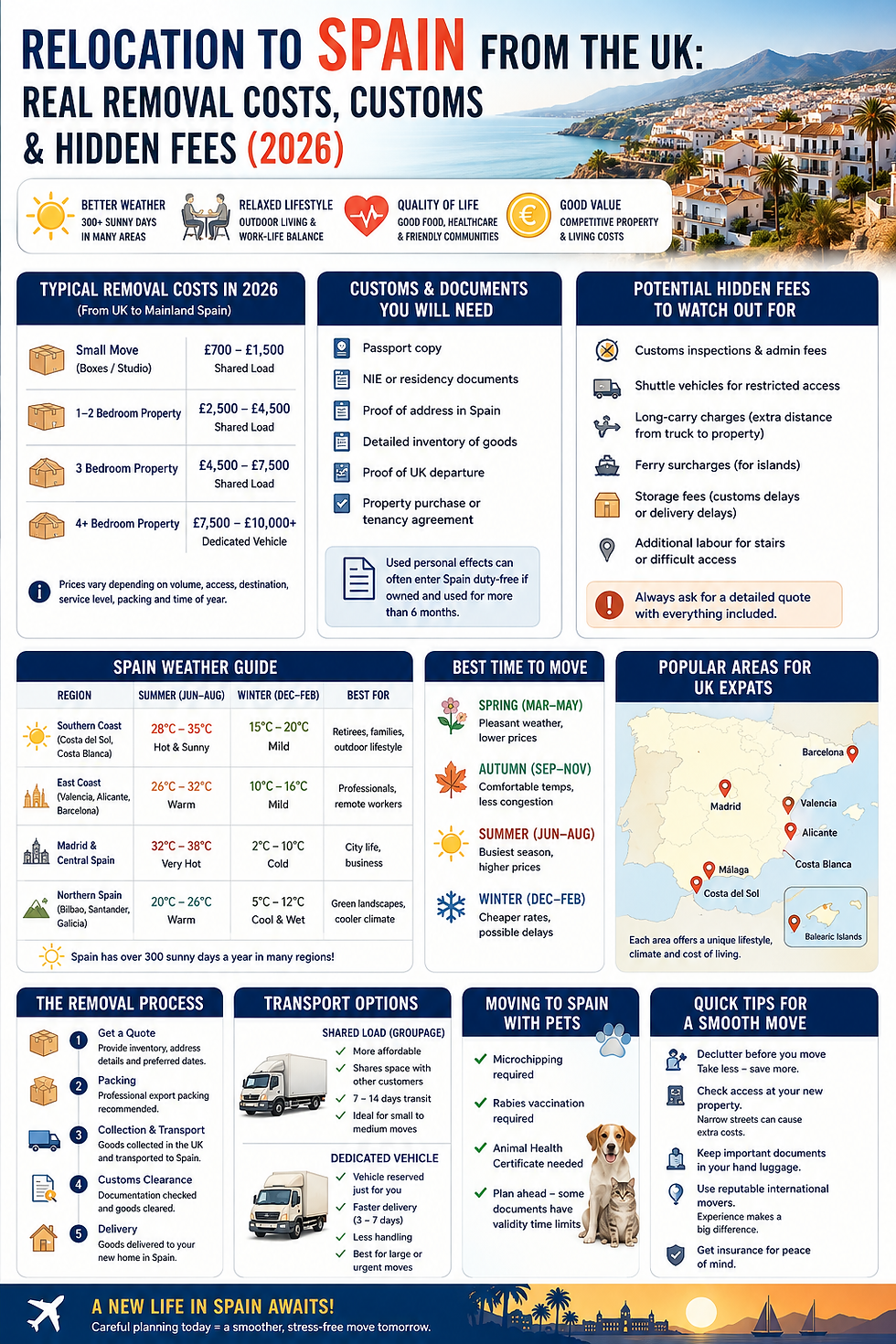
Realistic UK to Spain Removal Costs in 2026
One of the biggest misconceptions about international removals is that pricing is based purely on distance.
In reality, several operational factors affect the overall cost:
Shipment volume
Final delivery location
Vehicle accessibility
Packing requirements
Customs procedures
Storage needs
Service speed
Seasonal demand
Smaller moves involving only boxes or limited furniture may start from several hundred pounds via shared-load transport. Medium household relocations generally cost several thousand pounds, while larger full-household moves can exceed £10,000 depending on service level and destination region.
Dedicated vehicles are significantly more expensive than shared-load services because the truck is reserved exclusively for one customer’s shipment. However, they offer faster transit times, fewer handling stages, and greater scheduling flexibility.
Groupage or shared-load services remain extremely popular for Spain relocations because they provide a far more economical option for medium-sized moves. Rather than paying for an entire vehicle, customers share trailer space with other shipments travelling along similar routes through Europe.
This system works very efficiently for many relocations, particularly when customers are flexible on delivery timing.
Why Cheap Quotes Can Be Misleading
One of the most common issues within the international removals industry is unrealistic pricing.
Many customers naturally compare quotations based purely on headline price, but international relocation quotations often vary dramatically in what they actually include.
Some low-cost providers may exclude:
Customs handling
Destination access charges
Shuttle vehicles
Long-carry labour
Insurance
Packing materials
Delivery restrictions
Customs inspections
As a result, an apparently cheaper quotation can later become far more expensive.
This is particularly common in Spain because many older towns, apartment complexes, and coastal developments have limited truck access. In some areas, large vehicles simply cannot reach the property entrance.
Where this happens, movers may need to transfer goods into smaller shuttle vehicles, which creates additional labour, handling time, and operational costs.
Professional international movers usually explain these possibilities before booking, rather than surprising customers later.

Customs Procedures After Brexit
Brexit fundamentally changed how removals between the UK and Spain operate.
Household goods now pass through full customs procedures when entering Spain from the UK. While used personal effects can often still enter duty-free, customs authorities require accurate documentation and detailed inventories.
This is one of the most important differences between domestic and international moving.
Spanish customs may request:
Passport copies
NIE or residency documentation
Proof of address
Property purchase or rental agreements
Detailed inventories
Evidence goods have been owned and used
If paperwork is incomplete or inconsistent, shipments can face delays, inspections, or additional administrative requirements.
Professional inventory preparation has therefore become increasingly important. A detailed inventory not only assists customs clearance but also reduces confusion during delivery and helps support insurance coverage if required.
Why Professional Export Packing Matters
International removals involve far more handling than domestic UK moves.
A shipment travelling from the UK to Spain may pass through:
UK loading crews
Warehousing
Cross-border transport
Customs inspections
Destination handling teams
Final delivery crews
Because of this, professional export packing plays a major role in protecting household goods during transit.
High-quality export wrapping and carton packing helps reduce the risk of:
Transit damage
Moisture exposure
Compression damage
Glass breakages
Surface scratching
This becomes especially important for:
Artwork
Marble furniture
TVs
Antiques
Mirrors
Designer furniture
Many professional movers also discourage owner-packed boxes because customs authorities are more likely to inspect them, and insurance limitations may apply if damage occurs.

Popular Areas in Spain for UK Relocations
Different parts of Spain attract very different types of relocations.
The Costa del Sol remains especially popular with retirees and second-home owners because of its warm winters and established British communities.
Valencia has grown rapidly in popularity among younger professionals and remote workers because it offers beaches, modern infrastructure, and lower living costs compared to Barcelona or Madrid.
Barcelona attracts international business professionals and digital industries but presents greater logistical challenges during removals because of vehicle restrictions, narrow streets, and apartment access limitations.
Alicante and the Costa Blanca continue to attract UK families seeking affordability and strong expat networks.
The Balearic Islands, including Mallorca and Ibiza, remain desirable but usually involve significantly higher moving costs because of ferry logistics and island delivery complexities.
Relocating to Spain with Pets
Pet relocation has become more structured since Brexit.
Most dogs and cats travelling from the UK to Spain now require:
Microchipping
Rabies vaccinations
Animal Health Certificates
Timing becomes extremely important because some documents are only valid within certain travel windows.
Customers relocating with pets should also consider climate adaptation. Animals arriving from the UK may initially struggle with intense summer heat in southern Spain, particularly during July and August.
The Emotional Side of International Relocation
One area often overlooked in relocation guides is the emotional side of moving abroad.
International relocation is not only a logistics project — it is a major lifestyle transition.
For many people, the process involves:
Leaving familiar routines
Navigating new bureaucracy
Learning different systems
Adjusting to language barriers
Managing uncertainty during transport and customs clearance
This is why communication and move coordination matter so much.
A professional removals company should not simply transport boxes. They should guide customers through customs requirements, explain realistic timelines, manage expectations honestly, and reduce unnecessary stress throughout the process.
Relocating to Spain from the UK in 2026 remains an exciting opportunity for many people seeking lifestyle change, retirement, warmer weather, or a fresh start abroad.
However, international relocation today involves far more planning than many people initially expect.
Understanding:
Customs procedures
Seasonal timing
Real transport costs
Climate differences
Delivery restrictions
Hidden operational charges
can help avoid expensive surprises later.
The cheapest quote is rarely the cheapest overall move once delays, handling complications, or missing services are taken into account.
Choosing an experienced international removals company with genuine European relocation experience can make the entire process smoother, safer, and far less stressful — allowing customers to focus on settling into life in Spain rather than managing avoidable moving problems.
Frequently Asked Questions
How much does it realistically cost to relocate from the UK to Spain in 2026?
The cost depends mainly on shipment volume, destination region, property access, and whether you choose a shared-load or dedicated vehicle service. Smaller relocations may start from around £700–£1,500, while larger family household moves can exceed £10,000 once packing, customs support, and delivery logistics are included.
What hidden costs should I expect when moving to Spain?
Possible additional charges can include customs inspections, storage fees, shuttle vehicles for restricted-access properties, ferry surcharges for islands, long-carry labour charges, and temporary warehousing during customs clearance. Professional movers should explain these potential costs before booking.
Is moving to Spain after Brexit more difficult?
The process is more administrative than before Brexit because household goods now require full customs clearance procedures. However, with correct paperwork and experienced international movers, relocating to Spain remains straightforward for most customers.
Can I still move my household goods to Spain duty-free?
In many cases yes. Used personal belongings can often enter Spain without import duty if they have been owned and used for more than six months and the move is connected to residency transfer. Spanish customs authorities normally require supporting documentation and a detailed inventory.
What documents are usually required for a Spain relocation?
Most relocations require a passport copy, NIE or residency documentation, proof of address in Spain, a detailed inventory, and proof of departure from the UK. Depending on the situation, Spanish customs may request additional documents.
What is the cheapest way to move furniture from the UK to Spain?
Shared-load or groupage transport is usually the most economical option. This allows multiple customers to share trailer space within the same vehicle travelling to Spain, reducing transport costs significantly compared to dedicated vehicle services.
How long do removals to Spain usually take?
Shared-load removals generally take approximately 7–14 days for mainland Spain, although seasonal demand and regional access can affect delivery schedules. Dedicated vehicles are normally faster and can often deliver within 3–7 days.
Is it worth using a dedicated vehicle for a Spain move?
Dedicated vehicles are usually recommended for larger households, urgent relocations, high-value furniture, or customers who require direct delivery with minimal handling. While more expensive, they provide faster and more controlled transport.
What areas of Spain are most popular for British expats?
The Costa del Sol, Costa Blanca, Valencia, Alicante, Málaga, Marbella, Barcelona, and the Balearic Islands continue to attract large numbers of UK residents because of their climate, lifestyle, transport links, and established expat communities.
What is the weather really like in Spain year-round?
Spain’s climate varies significantly by region. Southern coastal areas enjoy hot summers and mild winters, while northern Spain is cooler and greener with more rainfall. Inland cities such as Madrid can experience both very hot summers and surprisingly cold winters.
When is the best time of year to relocate to Spain?
Spring and autumn are often considered ideal because temperatures are more comfortable and transport networks are less congested. Summer is usually the busiest and most expensive moving period due to increased demand across Europe.
Can I move to Spain with pets from the UK?
Yes, although Brexit introduced additional requirements. Most pets now require microchipping, rabies vaccinations, and an Animal Health Certificate before entering Spain from the UK.
Do I need professional packing for an international move?
Professional export packing is strongly recommended for international relocations because shipments experience multiple handling stages during transport and customs processing. Proper packing helps reduce transit damage and customs complications.
Why do some removals companies discourage owner-packed boxes?
Owner-packed boxes are more likely to be inspected by customs authorities, and insurance limitations may apply if damage occurs. Professionally packed shipments are generally easier to document and protect during long-distance transport.
Are there delivery restrictions in Spain?
Yes. Many Spanish city centres, coastal developments, apartment complexes, and older towns have restricted access for large vehicles. In some cases, shuttle vehicles or additional labour may be required to complete delivery safely.
Is Spain still a good relocation destination for UK residents in 2026?
For many people, absolutely. Spain continues to offer excellent weather, outdoor living, established expat communities, family-friendly areas, and a lifestyle that remains highly attractive to UK residents seeking long-term relocation abroad.

Planning a Relocation to Spain from the UK?
Every international move is different, and the right transport option will depend on your volume, destination, timing, and customs requirements.
Whether you are relocating a small apartment, a family household, or simply exploring your options for moving to Spain, obtaining professional guidance early can help avoid unexpected costs and delays later in the process.
At Reloux, we assist with:
UK to Spain removals
Shared-load and dedicated vehicle services
Professional export packing
Customs documentation guidance
Storage in transit
Delivery across mainland Spain and selected islands
If you would like advice on estimated costs, transit times, or the most suitable moving option for your relocation, you can request a tailored quotation or arrange a video survey with our team.