
Top Polish Cities for UK Expats: Where to Start Your New Life

By Reloux International Moving
Updated: 28 September 2026
Perhaps you are moving to be closer to family. Perhaps a new job is taking you overseas. Or perhaps you have visited Poland several times and started wondering what it would be like to stay.

At some point, the conversation becomes more specific. Where would you live? Would you want an apartment near cafés and tram stops, a family home outside the city, or somewhere close enough to the coast for an evening walk by the sea?
Removals to Poland gives you very different versions of that future. Warsaw has the energy of a capital. Kraków draws you into its historic streets. Wrocław spreads around rivers and islands. Along the Baltic, Gdańsk and its neighbours offer a different rhythm again.
If you are moving to Poland from the UK, choosing your city deserves time. This guide will help you picture the options, ask better questions and start planning the practical side of bringing your home with you.
Who is this guide for?
This guide is for British nationals relocating to Poland, Polish families returning after years in the UK, couples moving closer to relatives and anyone weighing up a new start. Your citizenship and family circumstances will affect the paperwork, but the everyday questions often overlap: where to live, how to find a suitable home and how to make the move manageable.
Top Polish Cities for UK Expats: a quick comparison
Start with Warsaw for capital-city life, Kraków for historic atmosphere, Wrocław for riverside surroundings, and Gdańsk or Gdynia for the coast. Poznań, Łódź, Katowice and Zielona Góra offer further possibilities depending on work, family and the pace you prefer.
These are editorial suggestions for Top Polish Cities for UK Expats, based on the cities’ characteristics. Use them to build a shortlist around your own priorities.
City or area | What makes it distinctive | A useful question before choosing |
Warsaw | Capital-city energy, cultural institutions and a wide range of urban amenities | Would your home, workplace and family routine fit comfortably within the same part of the city? |
Kraków | Historic streets, university life and a strong cultural identity | Would you enjoy living close to busy visitor areas, or prefer a residential district farther out? |
Wrocław | River islands, bridges and a lively historic centre | How well does your chosen neighbourhood connect with the places you need every day? |
Gdańsk, Gdynia and Sopot | Three distinct cities along the Baltic coast | Which gives you the right balance of sea access, housing and commuting? |
Poznań | A western Polish business and university city with substantial green spaces | Does its location suit your work and family connections? |
Łódź | Textile heritage, converted industrial spaces and film culture | Do the building and surrounding streets work as well as the apartment itself? |
Katowice | A cultural hub within a wider network of Silesian cities | Where will you spend most of your week across the region? |
Zielona Góra | A smaller western city with a wine-growing identity | Can you find the work, schooling and services your household needs locally? |
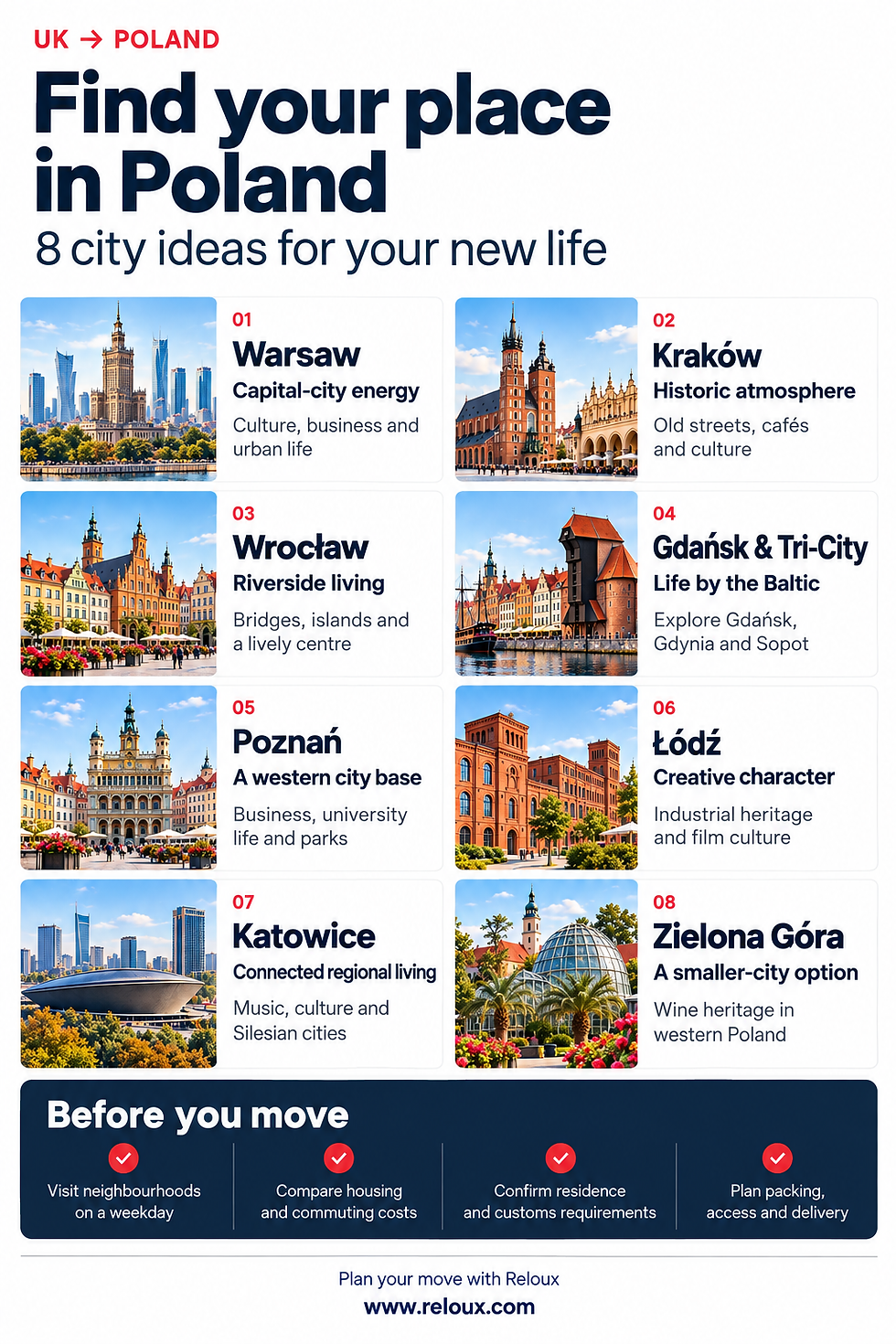
1. Warsaw: room to build a busy new life
Warsaw can suit people who enjoy having plenty of options. A working week might revolve around an office district, while weekends take you to the Vistula waterfront, Łazienki Park or the rebuilt Old Town. It is a city with several different personalities, and the skyline gives you only part of the picture.
The capital’s cultural and academic institutions make it worth considering if you want substantial city amenities around you. For the character of individual areas, explore places such as Saska Kępa and Praga as well as the centre. The Polish Tourism Organisation’s Warsaw guide is a useful introduction.
When searching for a home, put your likely workplace and any schools on the map first. An attractive apartment can feel much less convenient once you add two school journeys and a commute.
Your viewing-day task: travel from the property to work at the time you would actually leave home. Then walk to the nearest grocery shop and park. Those small journeys will become your everyday Warsaw.
2. Kraków: a city that gives you reasons to go outside
There is an obvious appeal to living somewhere you want to explore on foot. Kraków’s Main Market Square, Wawel and the streets of Kazimierz give it that quality. Its historic setting and cultural life make it an appealing starting point for anyone who values museums, cafés and a sense of place. You can explore its landmarks in the official Kraków city guide.
However, a weekend visit does not tell you everything about living there. A street that feels wonderfully lively on a Saturday evening may be less appealing when you need an early night before work.
Give yourself time to see residential areas and imagine a normal weekday. If you are considering an older apartment, ask about insulation, heating, the lift and where deliveries can stop. Characterful buildings can require a little more planning when moving furniture.
Kraków could suit you if having history and culture close by is a real part of the life you want, rather than something you enjoy only on holiday.
3. Wrocław: riverside walks and a lively city centre
Wrocław has a distinctive setting: bridges, islands and riverside spaces sit alongside its colourful Market Square and historic Ostrów Tumski. The small dwarf sculptures dotted around the city add a playful detail, particularly if you are exploring with children.
It is also a major economic, academic and cultural centre in south-western Poland. That combination gives you several reasons to investigate it, whether your move is connected to work, family or a preference for this region. See the official Wrocław guide for an introduction to its different attractions.
For a prospective resident, the next step is practical. Mark the places you will visit regularly and test the journeys between them. A central flat, a residential neighbourhood and a house beyond the city can each offer a different version of life here.
Try this before deciding: spend part of your visit following your proposed weekday routine. Work from a café if that reflects your plans, try the school journey, and see how the area feels once the sightseeing is over.

4. Gdańsk, Gdynia and Sopot: choose your own coastal lifestyle
If being near the sea is high on your list, give the Tri-City proper attention. Gdańsk, Gdynia and Sopot are separate cities, and it helps to understand their differences before searching for a home.
Gdańsk has a historic waterfront and maritime heritage. Gdynia offers a more modern city setting. Sopot brings a resort atmosphere, with its beach and well-known pier. Together they give you several ways to combine city living with the Baltic coast. The Polish Tourism
Organisation’s Gdańsk and Tri-City guide is a useful place to begin.
Imagine how often you would realistically use the coast. Would you want to walk there from home, or would an occasional weekend visit be enough? That answer can change your property search considerably.
Also test any journey between the cities before committing. Treat the actual route from your front door to work as part of the viewing process.
One worthwhile extra visit: return outside the summer holiday season. See whether you enjoy the place when your plans involve ordinary errands as well as beach days.
5. Poznań: a western city worth a closer look
Poznań may not be the first name on every British mover’s shortlist, but it deserves a place in the conversation. It is a commercial and university city with an attractive historic centre, and its position in western Poland may fit particularly well with your family or work connections.
There are enjoyable details to discover, from the city’s famous town-hall goats and Saint Martin’s croissants to green spaces such as Citadel Park and the area around Lake Malta. The official Poznań guide provides a useful starting point.
For anyone choosing a long-term base, think about the shape of your week. Where would you work? Where would the children spend their afternoons? How often would you drive out of the city?
Poznań is worth investigating if you want to live in western Poland while keeping the amenities of a substantial city. Let the practical connections lead your neighbourhood search, then spend time seeing which area feels comfortable.
6. Łódź: for people drawn to creative spaces and industrial character
Łódź has a different visual character from Poland’s medieval city centres. Its textile history shows in red-brick factories and former industrial buildings, while places such as Manufaktura and Piotrkowska Street give you plenty to explore. Film is another part of the city’s identity: Łódź belongs to UNESCO’s Creative Cities Network as a City of Film.
That combination may appeal if you like converted buildings, cultural venues and a city with an individual look. The official Łódź guide offers a good introduction.
If a loft apartment catches your attention, look closely at the practical details. Ask about heating costs, sound insulation, storage and lift access. Measure the route into the apartment as carefully as the rooms themselves.
A useful house-hunting habit: walk several streets in each direction from the property. Check where you would shop, catch transport and go for an evening walk. The immediate surroundings deserve as much attention as the photographs in the listing.
7. Katowice: look at the whole region
Katowice is a useful reminder that choosing a city does not always mean staying within its boundaries. It sits among a network of Silesian cities, so your workplace, home and family activities may be spread across several places.
There is plenty of cultural character too. The Culture Zone, the Polish National Radio Symphony Orchestra’s concert hall and the distinctive brick buildings of Nikiszowiec give you a starting point for exploring. Katowice is also a UNESCO Creative City of Music. Read more in the official city guide.
If your job or relatives are in the region, draw your regular destinations on a map before deciding where to live. That may point you towards Katowice itself or a nearby community.
The practical advantage of this approach: you can assess several possible bases against the same routine. Compare the journeys and properties available, then decide which location gives your household the most workable week.
8. Zielona Góra: a smaller-city option in western Poland
A new life in Poland does not have to begin in one of its largest cities. Zielona Góra offers a different starting point, especially for people with family connections in the Lubusz region or a preference for a smaller urban centre.
Its wine-growing heritage gives it a distinctive identity. The Palm House and vineyard setting are among its best-known features, and the city’s wine traditions are a good introduction to the area. The official Zielona Góra guide explains more.
Before choosing a smaller city or a nearby village, work through the everyday essentials: employment, school places, language support, healthcare and transport. If you plan to work from home, check the internet connection at the exact property.
Zielona Góra could be worth a visit if your plans allow flexibility over location and you want to explore western Poland beyond the larger cities. Spend time in the surrounding area as well as the centre before narrowing your search.
How to find a home that suits your life
It is easy to save attractive property listings before deciding what you actually need. Write down your essentials first: bedrooms, workspace, storage, parking, outdoor space and a realistic journey to work or school.
If you can, arrange a visit that includes ordinary weekdays. Buy groceries, try local transport and walk around the neighbourhood after dark. A place becomes easier to judge when you have done something there beyond sightseeing.
Ask what the monthly payment really includes
Request a written breakdown of rent, building charges, heating, water, electricity, internet and parking. Ask which figures are fixed, which are advances and which depend on consumption. For a house, ask about the heating system and available bills from previous seasons.
Check the furnishing inventory too. If you are moving into an equipped rental, bringing every large item from your UK home may create a storage problem on arrival.
Check the building as well as the home
Before arranging furniture delivery, confirm:
Which floor the property is on and whether there is a suitable lift.
Door, staircase and lift dimensions for your largest items.
How close a removal vehicle can park.
Whether gates, loading areas or vehicle restrictions affect access.
Who must arrange building permissions or reserve the lift.
A photograph of the entrance and street can help your mover assess access. If the property is being renovated, wait for a realistic handover plan before fixing delivery arrangements.
Budgeting for Poland: build the picture around your household
The useful question is how much your preferred life will cost in the place you choose. A central apartment, private schooling, a car and frequent UK visits produce a different budget from a smaller home near work and relatives.
Budget item | What to include |
Housing | Rent or mortgage, building charges, utilities, heating and parking |
Family life | Childcare, school fees where applicable, meals, activities and transport |
Travel | Local journeys, vehicle costs and trips back to the UK |
Getting established | Deposit, temporary accommodation, household purchases and professional assistance where needed |
The removal | Packing, transport, customs services, optional cover, access charges and possible storage |
If your income remains in pounds while your bills are in Polish złoty, include exchange-rate movements and transfer charges in your planning. Leave room for overlapping costs: you may be paying for your UK home while your Polish tenancy has already begun.
Keeping UK employment or business income also deserves an early conversation with your employer and a suitably qualified tax adviser about the arrangements for working from Poland.
Everyday life: give yourself time to settle
The first weeks can involve unfamiliar forms, new routes and a surprising number of small decisions. Build some breathing space into your plans.
Learning useful Polish phrases can help with appointments, deliveries and conversations with neighbours. If you are moving with children, contact schools early about places, language support and the documents they require. A regular activity can also give the whole family something familiar to look forward to each week.
Arrange healthcare before you need it. Your route to cover depends on your circumstances; the UK government’s healthcare guidance for Poland explains the principal arrangements, including NFZ and eligible S1 cases. A travel health card is not a substitute for arranging the cover required when you settle.
British nationals should also establish the appropriate residence and work route before committing to their move. Polish citizens returning home and households with different nationalities may have different requirements. Start with the official Living in Poland guidance and the Polish authorities it links to.

Moving your belongings from the UK to Poland
Once you have a likely address, the household move becomes much easier to plan. A clear inventory and accurate access information allow the quotation to reflect the work involved.
Decide what earns its place in the new home
A favourite chair, a good mattress and familiar possessions can help a new property feel like yours. Other items may be expensive to move relative to their usefulness or may not fit the new layout.
Measure larger furniture and compare it with the floor plan. Include loft, garage and garden contents in your inventory. If you are undecided about several items, tell your mover so the quoted volume can be reviewed before booking.
Discuss the service and your dates together
Ask which transport options are available for your route and shipment. A shared-load service combines consignments and may suit a smaller move with flexible dates. A dedicated vehicle can offer different scheduling options, subject to the service agreed.
Request a clear explanation of the collection date, expected delivery window and anything you must complete before dispatch. Customs clearance, access and operational arrangements can affect timing, so make sure the plan works with your accommodation and handover dates.
Prepare customs documents early
Household goods moving from Great Britain to Poland require customs arrangements. Eligible people transferring residence may obtain customs-duty relief on personal belongings, subject to conditions and supporting evidence. VAT and any excise treatment must be checked separately.
Ask the customs representative for a document list tailored to your move and flag new purchases or unusual items. The Polish tax authority’s transfer-of-residence guidance sets out the customs rules. If your collection is in Northern Ireland, ask for advice specific to that origin.
Keep your first few days within reach
Travel with important documents, essential medication, chargers, changes of clothes and anything children need to feel settled. Label boxes by room and identify everyday items you will want early. It is much easier to enjoy the first evening when you can find the kettle and bedding.
Frequently asked questions about relocating to Poland
Which Polish city should I visit first if I have never lived in Poland?
Start with the strongest reason behind your move. If that is a job, visit the city and neighbourhoods connected to it. If you have more freedom, compare two contrasting options: Warsaw and Poznań, for example, or Kraków and Gdańsk. Stay long enough to try ordinary routines. A few weekdays can tell you more about your preferences than rushing through several city centres.
Which city is best for a family moving from the UK?
Begin with the schools, childcare and support network your family needs. Then look for housing within a workable journey. A relative nearby, an available school place or a shorter commute may matter more than a city’s reputation. Ask schools directly about admissions, language support and the transition for your child’s age group.
Can I settle in Poland without speaking Polish?
Your experience will depend on your workplace, neighbourhood and support network. Ask prospective employers, schools and service providers which languages they use rather than assuming English will be available. Arrange help for important documents you cannot confidently understand, and start learning practical Polish before the move. Even a modest vocabulary can make everyday interactions easier.
Should I rent before buying a home in Poland?
Renting can give you time to learn the area and test a commute before a larger commitment. It is particularly useful if you are unsure about schools, neighbourhoods or how much space you need. Balance that flexibility against the cost of temporary housing and potentially moving twice. If purchasing, establish the legal requirements for your nationality and property type before committing.
Is moving all my furniture to Poland worthwhile?
Compare the cost of moving each larger item with its condition, replacement cost, sentimental value and usefulness in the new property. Check the destination’s existing furniture and measure access. Keeping good-quality or meaningful belongings may make sense; items that will not fit or will remain in storage deserve another look. A survey helps establish the volume and handling requirements.
How much do removals from the UK to Poland cost?
A useful quotation needs your inventory, collection and delivery addresses, access details, packing requirements and preferred dates. Volume, handling, transport service and any storage all affect the price. Compare written inclusions carefully, especially customs services, optional protection, unpacking and possible access charges. Bedroom count alone will not show how much you are moving.
What happens if I add items after receiving a quotation?
Send an updated inventory before collection. Additional furniture or boxes can change the space, packing materials and labour required, which may affect the price or schedule. Ask your mover to confirm the revised scope in writing. It is easier to deal with changes while the transport is being planned.
Can I arrange the move before my Polish property is ready?
You can begin the survey and quotation process while dates are developing. If collection must happen before the property is available, discuss storage and later delivery. Ask about handling charges, storage rates, notice needed for release and the likely delivery window. Give your mover a realistic completion date and update it promptly if building work or handover is delayed.
Does a removals quotation include insurance and unpacking?
Check the individual quotation. Optional shipment protection, unpacking, assembly and debris removal may have separate terms or charges. Ask what cover is available, how values are declared, what exclusions apply and whether owner packing changes the position. Confirm exactly what the delivery team will do inside the property.
A good move starts with a place that fits your life
Top Polish City for UK Expats is the one where you can imagine a comfortable ordinary week: a manageable journey to work, somewhere you enjoy walking, the services your family needs and people you want to spend time with.
You do not have to decide everything at once. Choose a couple of places, spend time there and let the practical details help you narrow the choice.
When you are ready to plan the household move, Reloux International Moving can help you explore the next steps. Share your UK collection address, intended destination, approximate inventory and preferred dates to discuss current service availability, arrange a survey and request a quotation.
A clear plan for your belongings gives you more room to look forward to the home you are creating in Poland.


