
The Reality of Moving to Portugal From the UK in 2026

This guide is for British families, retirees, remote workers, and professionals planning a long-term or permanent move to Portugal in 2026.
Portugal continues to attract thousands of people from the UK every year. For many British expats, the idea of living somewhere sunnier, safer, and less stressful than the UK feels increasingly attractive. The promise of coastal living, better weather, outdoor cafés, lower daily costs, and a more relaxed lifestyle has made Portugal one of the most popular relocation destinations in Europe.
But the reality of moving to Portugal from the UK in 2026 is very different from what many people expect.
Social media often presents relocation as simple and effortless. Videos about “escaping Britain” rarely mention customs paperwork, delayed residency appointments, property competition, complicated shipping logistics, or the emotional pressure of starting life again in another country.

Since Brexit, moving to Portugal is no longer just a European move. It is a full international relocation involving customs clearance, immigration requirements, export documentation, and careful transport planning. Many people discover this only after they begin the process.
That does not mean moving to Portugal is a bad decision. In fact, many British expats say it was one of the best decisions they ever made. But those same people also admit they underestimated how much preparation was required before leaving the UK.
This guide explains the real reality of moving to Portugal from the UK in 2026, including the lifestyle changes, hidden challenges, international removals process, shipping furniture to Portugal, healthcare, residency, costs, and what British expats genuinely wish they had known earlier.
Why Portugal Continues to Attract British Expats
Portugal appeals to a surprisingly wide range of people from the UK.
Retirees are drawn to the climate, slower pace of life, and strong expat communities in places like the Algarve and Madeira. Younger professionals and remote workers are increasingly moving to Lisbon and Porto because of the growing international business culture, modern infrastructure, and better work-life balance. Families are often attracted by safety, outdoor living, and the possibility of a different lifestyle for their children.
For many people, the appeal of Portugal is not just financial. It is emotional.
Life in Portugal often feels calmer. Meals last longer. People spend more time outside. Daily routines can feel less rushed than in major British cities. The climate naturally encourages outdoor living, socialising, and a slower pace of life.
That change alone is one of the main reasons many British expats never return to the UK permanently.
However, there is also another side to the reality.
Some British people move to Portugal expecting a permanent holiday atmosphere, only to realise that everyday life abroad still includes bureaucracy, bills, work stress, healthcare administration, banking problems, and cultural adjustments.
Portugal can absolutely improve quality of life, but it does not automatically remove the pressures of normal life.
Brexit Completely Changed the Relocation Process
One of the biggest shocks for many British expats is realising how much Brexit changed European relocation.
Before Brexit, many UK citizens moved across Europe relatively freely. Today, Portugal relocations involve customs procedures, residency planning, and immigration rules that did not previously exist.
This affects:
International removals to Portugal
Shipping furniture to Portugal
Residency rights
Healthcare access
Vehicle imports
Banking setup
Tax residency
Long-term living rights
British citizens are now treated as non-EU nationals.
That means moving to Portugal from the UK in 2026 requires proper planning well before the moving truck arrives.
Official UK government guidance can be found here:
Many people underestimate how long residency paperwork and document preparation can take. Waiting until the last minute often creates unnecessary stress.
The Emotional Reality of Leaving the UK
One part of relocation that many blogs ignore is the emotional side of moving abroad.
Selling or leaving a family home, saying goodbye to relatives, changing routines, leaving familiar healthcare systems, and adapting to another country can be psychologically exhausting even when the move is exciting.
The first few months in Portugal can feel emotionally inconsistent for many expats.
One day may feel incredible:
Coffee beside the ocean
Sunshine in winter
Lower stress levels
Beautiful scenery
Better weather
The next day may involve:
Residency delays
Internet installation problems
Banking issues
Customs paperwork
Language barriers
Homesickness
This emotional contrast is completely normal.
Many British expats say the first 6 to 12 months are the adjustment period where expectations slowly become reality.
Those who succeed long-term usually arrive with realistic expectations rather than fantasy ideas about permanent holiday living.
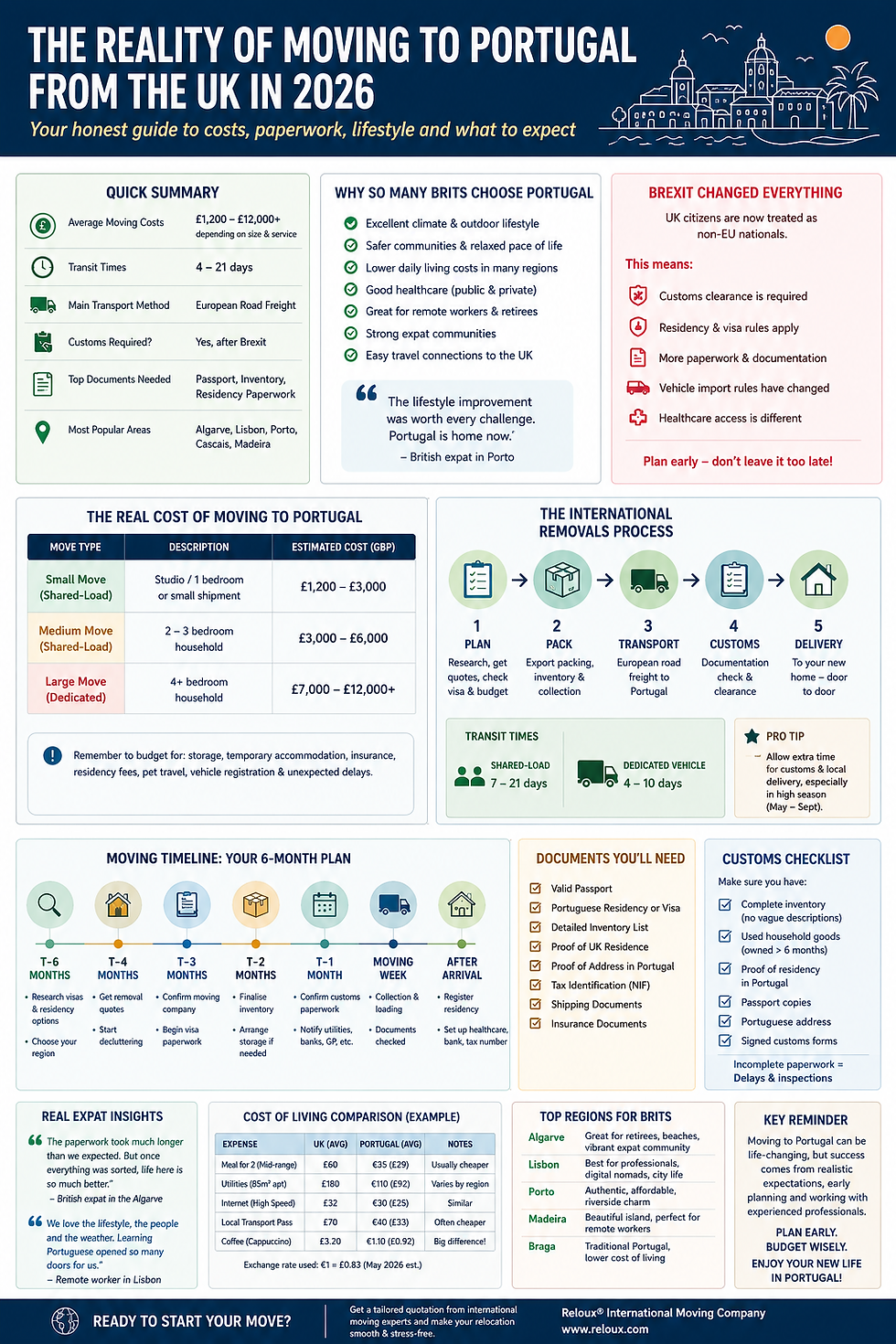
The Real Cost of Moving to Portugal From the UK
The cost of moving to Portugal varies enormously depending on the size of the move and the level of service required.
Smaller shared-load removals to Portugal from the UK may cost between £1,200 and £3,000. Larger household relocations using dedicated vehicles and professional export packing can exceed £10,000 depending on destination and shipment size.
But the actual moving costs are only one part of the financial reality.
Many British expats underestimate secondary relocation expenses such as:
Temporary accommodation
Storage costs
Residency fees
Delayed property completion
Pet relocation
Additional delivery access charges
Insurance
Furniture replacement
Vehicle registration costs
People moving to Portugal often budget only for transport and forget the wider relocation picture.
This is especially true when moving to older Portuguese towns or coastal regions where difficult access can affect delivery logistics.
Large removal vehicles cannot always park directly outside properties in historic Portuguese towns. Narrow streets, steep hills, restricted parking, or apartment buildings without lifts can all increase delivery complexity.
Professional international moving companies normally assess this carefully during surveys.
Shipping Furniture to Portugal Is Usually Done by Road Freight
Many people assume overseas removals automatically involve shipping containers and sea freight.
In reality, most removals to mainland Portugal from the UK are completed by European road freight.
Road transport is normally faster, simpler, and more practical for household removals because goods remain on the same vehicle for most of the journey.
Most customers choose between two main transport options.
The first is shared-load removals, where several customers share vehicle space. This reduces costs and works well for smaller household shipments or flexible delivery schedules.
The second is dedicated transport, where one vehicle is assigned directly to a single client’s move. This is usually preferred for larger homes, urgent relocations, or families wanting faster transit times.
Transit times vary depending on:
Customs clearance
Collection scheduling
Delivery region
Traffic conditions
Ferry crossings
Seasonal demand
Shared-load removals to Portugal typically take longer than dedicated services because routes are consolidated between multiple deliveries.
Professional movers such as Reloux® International Moving Company usually recommend allowing flexibility for delivery scheduling, particularly during busy summer relocation periods.

Customs Clearance Is One of the Most Stressful Parts
Customs is often the part people worry about the most.
Since Brexit, UK to Portugal removals now require customs procedures that simply did not exist before.
Used household goods may qualify for duty-free import relief under certain conditions, but eligibility depends on documentation, residency status, and customs approval.
Portuguese customs authorities may request:
Passport copies
Residency documentation
Detailed inventories
Proof of previous UK residence
Portuguese address confirmation
Shipping paperwork
One of the biggest mistakes people make is assuming customs paperwork is simple.
It is not.
Incomplete inventories, vague box descriptions, or owner-packed shipments can increase inspection risks and delays.
This is why professional export packing matters so much for international removals.
Export packing is not just about protecting furniture. It also helps create accurate inventories, improves customs compliance, and reduces handling risks throughout the transport process.
Many experienced movers strongly discourage self-packing for overseas relocations because customs inspections become more likely when inventories are incomplete or inconsistent.
Portuguese customs guidance can be found here:
Portuguese Bureaucracy Is Slower Than Most Brits Expect
One of the biggest cultural differences British expats mention after moving to Portugal is administration speed.
Portugal is generally relaxed, but that relaxed pace can sometimes extend into bureaucracy and paperwork.
Opening bank accounts, arranging tax registration, registering healthcare access, importing vehicles, or organising residency appointments can all take longer than many British people expect.
For people coming from fast-paced UK systems, this can initially feel frustrating.
The reality is that patience becomes an important part of living abroad.
Many expats who adapt successfully eventually accept that things move differently in Portugal. Fighting constantly against that pace often creates unnecessary stress.
The Housing Reality Is More Competitive Than Many People Expect
Portugal’s popularity has increased property demand significantly over recent years.
This is especially noticeable in:
Lisbon
Cascais
Porto
Algarve coastal towns
Madeira
Rental competition can be intense in some regions, particularly for high-quality long-term accommodation.
Some British expats arrive expecting cheap luxury apartments everywhere and are surprised by:
Rising rental prices
Limited housing supply
Agency requirements
Upfront payment requests
Competition from international buyers
The dream of inexpensive coastal living still exists in some areas, but prime locations have become substantially more expensive than many older blogs suggest.
Researching local property markets carefully before relocating is extremely important.
Healthcare in Portugal
Healthcare is one of the strongest positives many British expats mention after relocating.
Portugal offers both public and private healthcare systems, and private healthcare is often considered affordable compared with UK private medical costs.
Many expats initially choose private medical insurance while residency paperwork is being completed.
Private healthcare is popular because:
Waiting times are often shorter
English-speaking doctors are easier to find
Clinics are widely available
Costs remain relatively reasonable
Official NHS guidance for UK citizens abroad is available here:
Healthcare access after Brexit depends on residency arrangements and individual circumstances, so researching this properly before relocation is important.
Learning Portuguese Makes a Bigger Difference Than Expected
A common myth is that British expats can comfortably live in Portugal forever using only English.
While English is widely spoken in tourist areas and expat regions, relying entirely on English can become limiting outside those environments.
Even basic Portuguese makes a major difference when:
Visiting local government offices
Speaking with tradespeople
Attending healthcare appointments
Integrating socially
Handling bureaucracy
Many expats say daily life improved dramatically once they learned simple conversational Portuguese.
Locals also generally appreciate the effort, even when language skills are basic.

The Reality of Portuguese Work Culture
For remote workers and professionals, adapting to Portuguese work culture can take time.
Compared with the UK, Portugal often feels less aggressive and less corporate in everyday interactions. Work-life balance is usually prioritised more heavily.
However, salaries in Portugal are generally lower than in Britain, which surprises some people considering local employment opportunities.
This is one reason Portugal remains especially attractive for:
Remote workers
Online business owners
Retirees
Freelancers
People earning foreign income
Those arriving with UK-based income often experience a significantly better lifestyle balance.
What Surprises Most Brits After Moving to Portugal
The biggest surprises often include things people never researched before relocating.
Many British expats are surprised by:
How slow bureaucracy can feel
Property rental competition
Winter humidity in some homes
Delivery access problems in older towns
Increased paperwork after Brexit
Administrative delays
The emotional adjustment period
The importance of learning Portuguese
At the same time, many expats say they underestimated the positive changes too.
People often report:
Lower stress levels
More outdoor living
Better mental wellbeing
Stronger family time
Improved lifestyle balance
Greater sense of calm
For many people, these long-term lifestyle improvements outweigh the relocation challenges.
Portugal vs Surrounding Countries: Which Is Better for British Expats?
One of the biggest reasons Portugal continues attracting British expats is that it often offers a balance many nearby European countries struggle to provide. Compared with some surrounding countries, Portugal is generally viewed as safer, more relaxed, and easier to adapt to for English-speaking expats.
However, every country offers different advantages depending on your lifestyle, budget, work situation, and long-term goals.
Some people moving abroad prioritise sunshine and beaches. Others care more about tax systems, healthcare, infrastructure, schools, or affordability. This is why many British families compare Portugal with Spain, France, Italy, or even southern regions of Europe before making a final relocation decision.
Portugal Compared With Nearby European Countries
Factor | Portugal | Spain | France | Italy |
Climate | Warm, sunny, mild winters | Hot summers, varied winters | Cooler overall | Mediterranean south, colder north |
Cost of Living | Moderate | Moderate to high in cities | Generally higher | Varies by region |
Pace of Life | Relaxed | Relaxed | Faster in cities | Slower outside major cities |
Healthcare | Very good public & private | Excellent | Excellent | Good but regional differences |
English Spoken | Common in expat areas | Moderate | Less common outside tourist areas | Less common |
Property Prices | Rising but still competitive | Higher in prime coastal areas | Often expensive | Mixed depending on region |
Safety | Very high | High | Moderate to high | Moderate |
Bureaucracy | Slow but manageable | Complex | Administrative-heavy | Often complicated |
Popular for UK Expats | Extremely popular | Extremely popular | Moderate | Growing interest |
Best For | Lifestyle balance | Beach lifestyle & cities | Careers & education | Culture & slower living |
Why Many Brits Still Choose Portugal
Portugal often wins over British expats because it combines several lifestyle advantages together:
Better weather than most of Europe
Strong safety reputation
Coastal living opportunities
Lower stress lifestyle
Established expat communities
Good private healthcare
Friendly atmosphere toward foreigners
Easier adaptation for retirees and remote workers
Compared with Spain, Portugal is often viewed as slightly calmer and less crowded, particularly outside Lisbon and the Algarve. Compared with France, the overall lifestyle tends to feel less formal and generally more affordable in many regions.
Italy remains attractive for culture and food, but many expats find Portuguese bureaucracy and infrastructure easier to navigate overall, despite the delays that can still happen after Brexit.
Portugal vs Spain for British Expats
Spain remains Portugal’s biggest competitor for UK expats.
Spain offers:
Larger cities
Bigger property market
Strong international infrastructure
Extensive coastal regions
Wider job market
However, many people relocating from the UK say Portugal feels:
Less hectic
Safer
More relaxed
Easier socially
Better balanced for long-term lifestyle living
Portugal also tends to attract more retirees and remote workers looking for quieter daily life rather than fast-paced city environments.
Portugal vs France
France appeals strongly to professionals, families, and people wanting stronger economic infrastructure.
However, France is often viewed as:
More expensive
More formal
More bureaucratic
Harder for English-only expats
Portugal usually feels easier for British retirees and lifestyle-focused relocations, especially in established expat regions.
Portugal vs Italy
Italy offers incredible culture, food, architecture, and scenery, but relocation logistics can sometimes feel more difficult depending on region.
British expats often describe Portugal as:
More organised overall
Easier for healthcare access
Better for remote working
More internationally connected
Simpler for coastal living
Italy still appeals strongly to people prioritising culture and traditional Mediterranean lifestyle, particularly in regions such as Tuscany or Lake Como.
Is Portugal the Best Country in Europe for British Expats?
There is no perfect answer because every relocation depends on personal priorities.
However, Portugal consistently ranks among the best European destinations for British expats because it offers a rare combination of:
Climate
Safety
Healthcare
Lifestyle
Accessibility
International communities
Coastal living
Work-life balance
For many people moving abroad from the UK in 2026, Portugal still provides one of the strongest overall lifestyle packages in Europe.

Is Moving to Portugal Still Worth It in 2026?
For many British expats, the answer is still yes.
Portugal remains one of Europe’s most attractive destinations for people seeking:
Better weather
Safer communities
Coastal living
Slower pace of life
Strong healthcare
Better work-life balance
International lifestyle opportunities
But the key difference in 2026 is that moving to Portugal now requires realistic preparation.
Successful relocations usually involve:
Early planning
Proper customs preparation
Professional export packing
Flexible delivery expectations
Financial contingency planning
Residency research
Patience during the adjustment period
Working with experienced international removals specialists such as Reloux® International Moving Company can help simplify the process through:
Door-to-door removals
Customs guidance
Export packing
Storage solutions
European road freight planning
Delivery coordination
For many British families, retirees, and remote workers, the lifestyle rewards still outweigh the complexity of the move itself.
Frequently Asked Questions
How difficult is it to move to Portugal from the UK after Brexit?
Moving to Portugal after Brexit is significantly more complex than before because UK citizens are now treated as non-EU nationals. The process often involves residency applications, customs clearance, shipping inventories, proof of address documentation, and long-term immigration planning. While the process is manageable, it usually requires far more preparation than many people initially expect.
How much money should you realistically budget for moving to Portugal?
Many people focus only on transport costs, but realistic relocation budgets should also include storage, temporary accommodation, insurance, customs-related expenses, deposits for rentals, residency paperwork, and emergency contingency funds. Full household relocations can easily cost several thousand pounds more than expected if these secondary expenses are ignored.
Is Portugal actually cheaper than the UK in 2026?
Portugal can still be cheaper than parts of the UK, particularly regarding restaurants, utilities, transport, and some regional property markets. However, Lisbon, Cascais, Porto, and premium Algarve locations have become much more expensive in recent years due to international demand. The idea that all of Portugal is “cheap” is no longer accurate.
What is the biggest mistake people make when moving to Portugal?
One of the most common mistakes is underestimating how much planning is required after Brexit. People often leave customs paperwork, residency applications, property research, or international removals arrangements too late. Another common issue is arriving without realistic financial reserves for unexpected delays or temporary accommodation.
How long do international removals to Portugal usually take?
Transit times vary depending on whether you choose shared-load or dedicated transport. Dedicated vehicle removals are usually faster, while shared-load services may take longer because multiple deliveries are consolidated together. Customs inspections, seasonal demand, ferry schedules, and delivery access conditions can also affect timing.
Is shipping furniture to Portugal worth it?
For many families, yes. High-quality furniture, sentimental items, and complete household contents are often worth transporting professionally. However, some people relocating to smaller Portuguese apartments or temporary rentals choose to reduce shipment size significantly to lower moving costs and simplify customs procedures.
Can UK citizens still retire to Portugal?
Yes. Portugal remains extremely popular with British retirees due to its climate, healthcare, safety, and lifestyle. However, retirees now need to consider residency pathways, healthcare arrangements, taxation, and proof of financial stability before relocating permanently.
What is life really like for British expats in Portugal?
Many British expats describe life in Portugal as calmer, healthier, and less stressful than in the UK. Outdoor living, better weather, slower daily routines, and improved work-life balance are commonly mentioned positives. However, people also mention frustrations with bureaucracy, administration speed, and language barriers during the adjustment period.
Is the Algarve still the best place for British expats?
The Algarve remains extremely popular because of its climate, beaches, golf communities, and established British expat population. However, property prices and rental demand have increased significantly. Some people now prefer areas such as Braga, Porto, or Madeira for lower costs and a more authentic Portuguese lifestyle.
Do I need professional export packing for removals to Portugal?
Professional export packing is strongly recommended for international removals because it improves customs compliance, reduces damage risks, and creates accurate inventories for overseas transport. Owner-packed shipments are more likely to experience customs inspections or insurance limitations.
Planning a Move to Portugal From the UK?
Whether you are relocating to Lisbon, Porto, Madeira, Cascais, or the Algarve, proper planning can make a major difference to your experience.
International removals specialists can help simplify:
Shipping furniture to Portugal
Export packing
Customs paperwork
Door-to-door transport
Storage in transit
Delivery coordination
Difficult access logistics
UK to Portugal removals planning
Request a tailored international removals quotation and start planning your move to Portugal in 2026 with experienced relocation professionals.

