
Moving from the UK to Sweden: Costs, Shipping, Customs & Removals Guide (2026)

Moving from the UK to Sweden is more than a simple relocation. It’s a major life transition that affects your finances, timeline, lifestyle, and the way you organise your daily routine. Many people assume that moving within Europe is straightforward, but since Brexit, the process has become more structured, more regulated, and far more dependent on proper planning.
This guide is designed to give you a clear, realistic understanding of what actually happens when you move your household goods from the UK to Sweden, the costs involved, the logistics behind the scenes, the customs rules you must follow, and the decisions that will shape your experience.

Living Standards and Why People Move to Sweden
Living in Sweden is often seen as a long-term lifestyle upgrade rather than just a relocation. People moving from the UK are typically motivated by stability, structure, and quality of daily life.
Sweden offers consistently high living standards, supported by strong public services, reliable infrastructure, and a well-balanced work culture. Working hours are generally structured, annual leave is generous, and there is a strong focus on maintaining a healthy work-life balance. For families, access to education and healthcare is a key factor, while professionals are drawn to stable employment conditions and transparent systems.
In terms of geography, Sweden is one of the largest countries in Europe, located in Northern
Europe as part of Scandinavia. It shares land borders with Norway and Finland, and is connected to Denmark via the Øresund Bridge. Its location provides strong logistical links across Europe, which supports efficient road transport for international removals.
The population of Sweden is just over 10 million people, with a large proportion living in urban areas such as Stockholm, Gothenburg, and Malmö. Despite its size, the country is not densely populated, which contributes to a quieter, less crowded living environment compared to many parts of the UK.
For many people, the decision to move to Sweden is not driven by one factor alone, but by a combination of lifestyle, environment, and long-term stability.
Who This Guide Is For
This guide is written for people who are actively planning or seriously considering a move to Sweden. It is especially relevant if you are:
relocating for work or a long‑term contract
moving with your family for a permanent or semi‑permanent stay
returning to the EU after living in the UK
transporting furniture, personal belongings, or a full household
looking for a structured, low‑risk relocation process
If you’re only sending a few parcels, this guide may be more detailed than you need. But if you’re moving furniture, boxes, or an entire home, this will give you clarity and help you avoid costly mistakes.
How Moving to Sweden from the UK Actually Works
On the surface, the process seems simple: your belongings are collected in the UK, transported across Europe, cleared through Swedish customs, and delivered to your new home. But behind that journey are several layers of planning and compliance that directly affect cost, timing, and stress levels.
A typical UK–Sweden move involves:
assessing the volume of your belongings
planning the transport route and schedule
preparing customs documentation
ensuring packing meets international standards
coordinating delivery access at your Swedish property
Each of these steps can influence the final price and the overall experience.
Cost of Moving from the UK to Sweden
The cost of your move is primarily based on volume, measured in cubic metres (CBM). The more space your belongings occupy, the higher the cost.
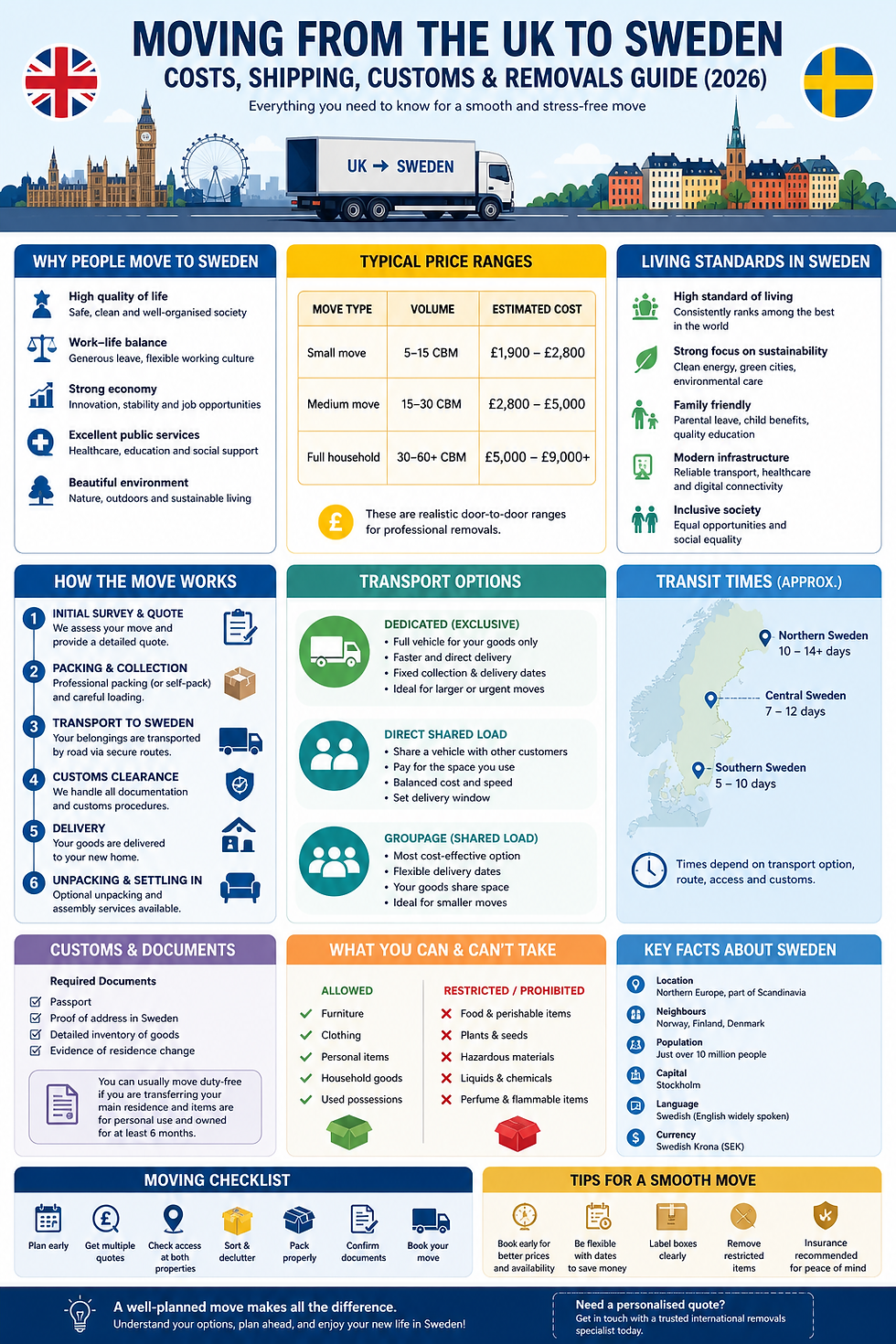
Typical Price Ranges
Move Type | Volume | Estimated Cost |
Small move | 5–15 CBM | £1,900 – £2,800 |
Medium move | 15–30 CBM | £2,800 – £5,000 |
Full household | 30–60+ CBM | £5,000 – £9,000+ |
These are realistic door‑to‑door ranges for professional removals.
What Actually Affects the Price
Two quotes may look similar, but the final cost often changes based on factors that aren’t obvious at first glance. The biggest cost influencers include:
access at your UK property (parking, stairs, distance to vehicle)
delivery conditions in Sweden (lifts, narrow streets, long carries)
whether you need professional packing
how quickly you need delivery
whether storage is required
how flexible your dates are
Many people choose the cheapest quote without understanding what’s excluded — and end up paying more later.
Shipping Options Explained Properly
All UK–Sweden household moves are transported by road. There is no sea freight option for standard removals between these countries.
The real difference lies in how your goods share space and how flexible your schedule is.
Transport Options
Option | How It Works | Cost | Speed | Best For |
Dedicated transport | Your goods only, full vehicle | High | Fast | Large or urgent moves |
Direct shared load | Shared vehicle with planned route | Medium | Moderate | Medium moves |
Groupage | Flexible shared load across routes | Low | Slowest | Small moves, flexible timing |
The Truth About “Cheap” Options
Lower‑priced quotes often involve:
long routing delays
minimal planning
limited control over delivery dates
missing destination charges
A cheap quote can easily become the most expensive option once delays, storage, or extra handling fees appear.
Transit Times from the UK to Sweden
Transit time depends on logistics, not just distance.
Typical delivery ranges:
Southern Sweden: 5–10 days
Central Sweden: 7–12 days
Northern Sweden: 10–14+ days
Dedicated transport is faster because it avoids consolidation stops.
Customs Clearance After Brexit
Even though Sweden is part of the EU, customs clearance is required when moving from the UK. Since Brexit, all household goods entering Sweden from the UK are treated as non-EU imports. This is one of the most commonly misunderstood parts of the relocation process.
When You Can Move Duty-Free
In many cases, you can import your household goods without paying customs duty or VAT, but only if specific conditions are met.
You will usually qualify if:
you are transferring your main residence to Sweden
you have owned and used the items for at least six months
the goods are for personal use and not intended for resale
you plan to live in Sweden for a minimum of 12 months
If these conditions are not met, taxes or duties may apply.
Documents You Will Need
To complete customs clearance, you will typically need:
passport
proof of address in Sweden
detailed inventory of goods
proof of residency or relocation
Incomplete or inaccurate documentation is one of the most common causes of delays at customs.
What You Can and Cannot Take
Allowed:
used household goods
furniture
clothing
personal belongings
Restricted or commonly problematic items:
food products
plants and organic materials
liquids, chemicals, or hazardous goods
perfumes and flammable items
Including restricted items in your shipment can result in inspections, delays, or additional charges.
Important Things Most People Miss
owner-packed boxes are more likely to be inspected
new or recently purchased items may be taxed
goods must not be sold or transferred shortly after import
customs may request additional documents at any stage
Official Guidance
For full and up-to-date regulations, refer to Swedish Customs (Tullverket), the official authority responsible for import rules when moving to Sweden.

Why Packing Matters More Than People Think
Packing affects both protection and customs compliance.
Professional packing ensures:
accurate inventory lists
reduced risk of damage
smoother customs inspections
Owner‑packed shipments are more likely to be opened and inspected.
Storage in Transit
Storage is often needed when:
your Swedish property isn’t ready
you’re renting temporarily
your delivery dates are uncertain
Storage is usually containerised and charged weekly.
Delivery Realities in Sweden
Swedish cities and towns can present challenges:
apartment buildings without lifts
narrow streets or restricted parking
long walking distances from vehicle to entrance
winter access issues in some regions
These factors can affect both cost and timing.
How to Estimate Your Moving Volume
Understanding volume helps you plan accurately.
Examples:
standard box: ~0.1 CBM
sofa: ~2 CBM
1‑bedroom flat: 10–20 CBM
3‑bedroom house: 40–60 CBM
Most people underestimate their volume by 20–30%.
When to Book Your Move
Timing affects availability and price.
Recommended booking windows:
normal periods: 2–6 weeks
summer: 4–8 weeks
large moves: as early as possible
Late bookings reduce your options and increase costs.
Common Mistakes People Make
The most frequent issues include:
choosing based only on price
underestimating volume
ignoring delivery access
packing restricted items
booking too late
Avoiding these mistakes saves time, money, and stress.

Benefits of Moving to Sweden
People choose Sweden for long‑term lifestyle reasons, including:
a stable economy
excellent work‑life balance
high‑quality public services
clean, sustainable living
access to nature and outdoor activities
Choosing the Right Move Type to Sweden
Instead of asking “What is the cheapest option?”, ask:
How quickly do I need delivery
How flexible are my dates
How important is certainty
If timing matters, dedicated transport is usually best. If budget matters, groupage is the most cost‑effective.
Simple Planning Checklist
Before you move, make sure you have:
an accurate volume estimate
confirmed access at both properties
reviewed customs requirements
removed restricted items
chosen the right transport option
Frequently Asked Questions
How much does it cost to move to Sweden from the UK?
The cost of moving from the UK to Sweden typically ranges from £1,900 to £9,000 or more, depending on the volume of your household goods and the service you choose. Smaller moves using shared transport are more affordable, while full-house moves with dedicated vehicles cost more. Factors such as access at both properties, packing services, and storage requirements can also affect the final price.
How long does moving to Sweden from the UK take?
Most removals to Sweden take between 5 and 14 days using road transport. Delivery times depend on your exact destination, the transport option selected, and how the route is scheduled. Dedicated transport is usually faster, while shared loads may take longer due to multiple stops and consolidation.
Can I pack my own belongings when moving to Sweden?
Yes, you can pack your own belongings, but it is generally not recommended for international removals. Owner-packed shipments are more likely to be inspected by customs, which can lead to delays. In addition, liability coverage is often limited for items not packed by professional removals teams.
Do I have to pay customs charges when moving to Sweden?
In most cases, you will not need to pay customs duties if you are moving your primary residence and your belongings meet eligibility requirements. Typically, items must have been owned and used for at least six months and be intended for personal use. Proper documentation is essential to avoid delays or unexpected charges.
What is the cheapest way to move from the UK to Sweden?
The most cost-effective way to move is by using a groupage or shared load service. This means your belongings share space in a vehicle with other customers, and you only pay for the volume you use. This option is ideal if you are flexible with delivery dates and do not require urgent transport.
How do I know how much space my move will require?
The most accurate way to determine your moving volume is through a professional survey, either by video or in person. Your belongings are measured in cubic metres (CBM), which is used to calculate transport costs. As a rough guide, a one-bedroom flat may require 10 to 20 CBM, while a three-bedroom house can range from 40 to 60 CBM.
Is road transport the only option for moving to Sweden?
Yes, for standard household removals from the UK to Sweden, road transport is the primary and most efficient option. It allows for direct door-to-door delivery and avoids the additional handling and delays associated with sea or air freight.
What items are not allowed when moving to Sweden?
Certain items are restricted or prohibited, including food, plants, hazardous materials, and flammable goods such as perfumes. Including restricted items in your shipment can cause delays or inspections, so it is important to check your inventory carefully before moving.
When should I book my move to Sweden?
It is recommended to book your move at least 2 to 6 weeks in advance. During busy periods such as summer, booking 4 to 8 weeks ahead is advisable to secure your preferred dates and avoid higher costs.
Do I need storage when moving to Sweden?
Storage in transit is often useful if your new home in Sweden is not ready or your dates are not confirmed. It provides flexibility and ensures your belongings can be delivered at the right time without pressure.
Final Thoughts
Moving from the UK to Sweden is straightforward when planned correctly, but small mistakes can lead to unnecessary delays and unexpected costs. Taking the time to understand your options, prepare your documentation, and choose the right transport method will make the entire process smoother and far less stressful.
If you are planning a move, use this guide as your foundation. The more informed you are, the easier your relocation will be.
If you prefer professional support, working with an experienced company such as Reloux can help ensure your move is properly planned and managed from start to finish, especially when it comes to packing, transport coordination, and customs clearance.
Ready to Plan Your Move?
If you want help estimating your volume, comparing transport options, or understanding customs requirements, I can create a personalised moving plan for you.
Just tell me your move size, dates, and where in Sweden you’re heading — and I’ll guide you step‑by‑step.

